The Architecture of Spirit: Swami Vivekananda’s Evolution of Prayer
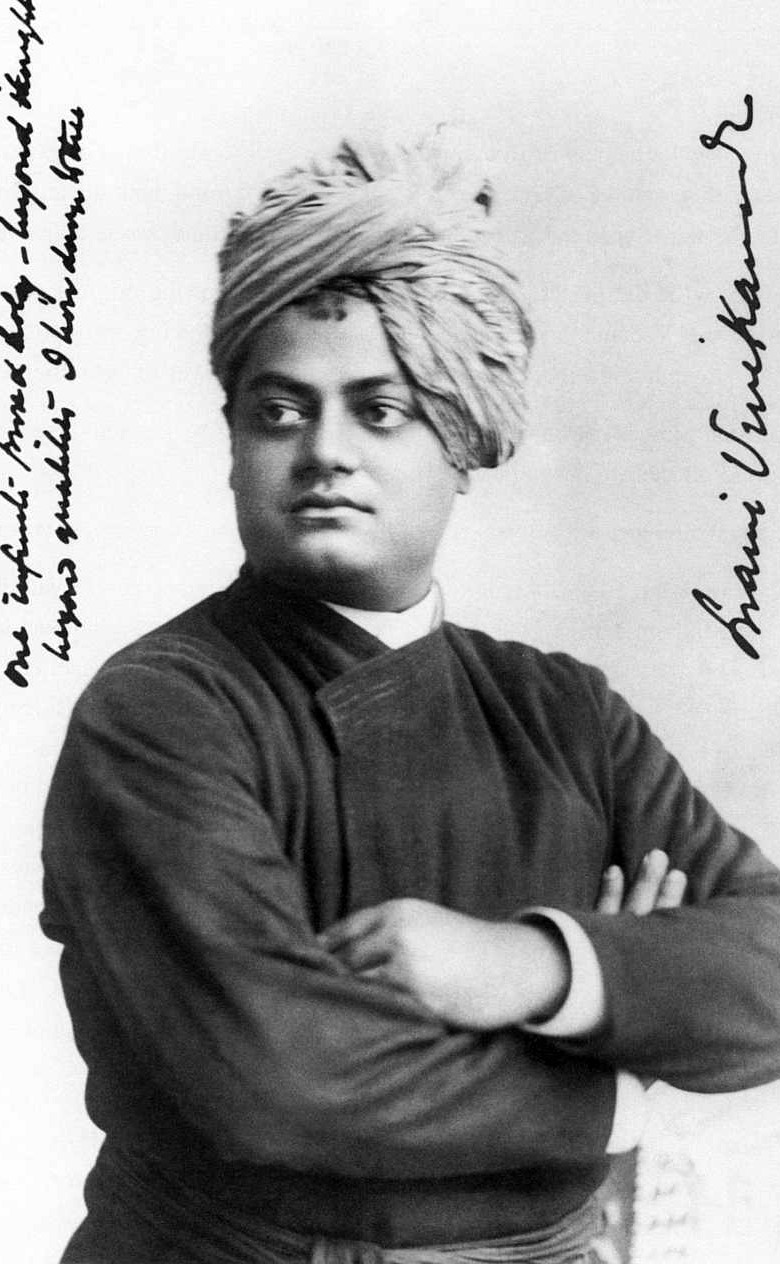 Swami Vivekananda in Chicago. In note on the left Vivekananda wrote: "One infinite pure and holy – beyond thought beyond qualities I bow down to thee".
To the world, Swami Vivekananda is the "Warrior Monk"—the fiery orator who brought Indian philosophy to the West and the champion of "Practical Vedanta."
Yet, beneath the public persona lay a meticulously constructed interior life. His spirituality was not a sudden burst of lightning; it was a deliberate architecture of the spirit, built upon a foundation of relentless skepticism, refined by the fires of personal loss, and eventually crowned by a revolutionary understanding of what it means to communicate with the Divine.
For Vivekananda, prayer was never a passive ritual of petition. It was an evolution—a journey from the "why" of the intellect to the "how" of the soul.
1. The Foundation: From Skepticism to Direct Perception
As a young man in Calcutta, Narendra was a member of the Brahmo Samaj, valuing logic and social reform above all else. His intellectual curiosity left him restless, leading him to challenge every spiritual authority he met with a blunt, audacious question: "Sir, have you seen God?"
Most gave him philosophical jargon. Then, he met Sri Ramakrishna Paramahamsa at Dakshineswar. When Narendra asked his signature question, Ramakrishna replied without a moment’s hesitation:
"Yes, I have seen Him just as I see you here, only in a much intenser sense."
This encounter was the first pillar of his spiritual architecture. It taught him that the goal of prayer wasn't about repeating words; it was about direct perception.
2. The Transformation of Prayer: The "Stone" Mother
Perhaps the most touching incident regarding his prayer life occurred after his father’s death. The family was plunged into poverty. Starving and desperate, Narendra asked Ramakrishna to pray to the Divine Mother (Goddess Kali) to alleviate his family's suffering.
Ramakrishna told him, "Go to the temple yourself and ask. She will give you what you need."
Narendra entered the temple, overwhelmed by the living presence of the Divine. But when he stood before the deity, he forgot about money, food, and his family’s plight. Instead, he prayed: "Mother, give me discrimination! Give me renunciation! Give me knowledge and devotion!"
He returned to Ramakrishna, who asked if he’d secured the "bread and butter." Realizing he'd forgotten, Narendra went back a second and third time. Each time, the result was the same. He found it impossible to ask the Infinite for "salt and pottage." This moment defined his spiritual maturity— prayer was no longer a shopping list for the ego, but a merger of the soul with the Divine.
3. The Power of Concentration: The Wasp and the King
Vivekananda’s prayer life was deeply rooted in Dhyana (meditation). He often told a story from his childhood to illustrate the power of focus. Once, while meditating, a wasp stung him. His friends were horrified, but Narendra didn't even flinch. He was so deeply "in-drawn" that the physical sensation of pain could not penetrate his consciousness.
For him, prayer was unbroken concentration. He believed that if you could hold one thought for twelve seconds, you were meditating; if you could do it for twelve times twelve, you were in a state of Samadhi.
4. Chicago: The Prayer of Universal Brotherhood
In 1893, at the Parliament of the World’s Religions in Chicago, Vivekananda didn't start his speech with a formal prayer to a sectarian God. He began with: "Sisters and Brothers of America."
The two-minute standing ovation that followed wasn't just for his charisma. It was a response to a man whose very life had become a prayer for humanity. He later said that his "prayer" during his wanderings across India was for the "Daridra Narayana"—the God who resides in the poor. He famously stated:
"He who sees God in the poor, in the weak, and in the diseased, really worships God."
Summary of His Philosophy on Prayer
Vivekananda’s approach to prayer can be distilled into these core principles:
| Purpose |
Not to change God’s mind, but to change our own nature. |
| Method |
Focus and "unswerving" concentration of the mind. |
| Service |
Serving humanity is the highest form of prayer (Jiva is Shiva). |
| Strength |
Anything that makes you weak — physically, intellectually, or spiritually — reject as poison. |
Vivekananda's life teaches us that prayer isn't an escape from reality; it is the ultimate preparation to face it with the heart of a lion and the soul of a saint.