Martin Luther King Jr.: When Faith Became Courage in the Face of Hatred
The Night He Was Ready to Give Up
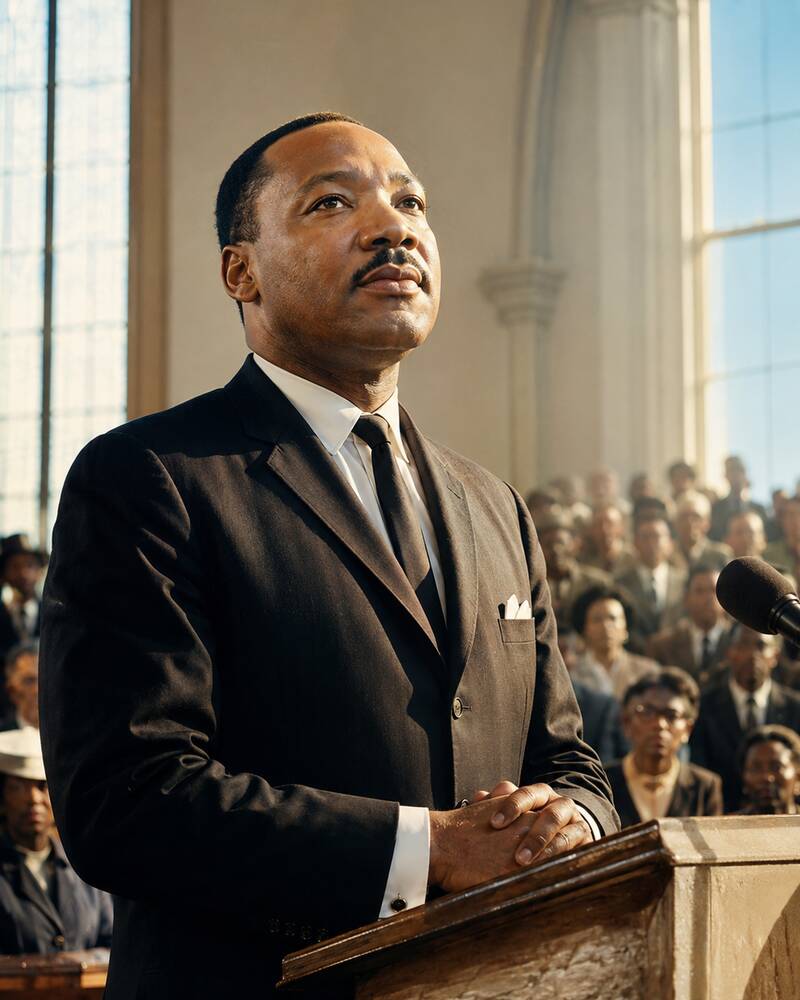 AI-generated historical reconstruction of Martin Luther King Jr. at a church pulpit. It is an illustration, not an authentic photograph of a particular event.
Late one night in January 1956, Martin Luther King Jr. sat alone at his kitchen table in Montgomery, Alabama. A cup of coffee stood untouched before him.
Only a few weeks earlier, Rosa Parks had been arrested for refusing to surrender her bus seat to a white passenger. The Black residents of Montgomery responded with a one-day bus boycott. When almost all of them stayed off the buses, local leaders decided to continue the protest and formed the Montgomery Improvement Association.
King, a twenty-six-year-old pastor who was relatively new to the city, was elected its president. He had not begun the movement. Women such as Jo Ann Robinson, experienced organisers such as E. D. Nixon, local ministers and thousands of ordinary residents had prepared and sustained it. But King suddenly became its most visible voice.1
The boycott continued. People walked long distances, organised carpools and endured pressure from employers and city authorities. Threatening letters and telephone calls began arriving at King’s home.
On one of those late-January nights, a caller threatened his life and family. King went to the kitchen, unable to sleep. He thought of withdrawing from leadership without appearing cowardly. He later recalled that his courage had almost disappeared.
Then he prayed aloud. He admitted his fear, his weakness and his inability to continue alone.
King testified that, in that exhausted moment, he experienced God’s presence in a way he had never experienced before. He believed he heard an inner assurance:
“Stand up for righteousness, stand up for truth; and God will be at your side forever.”
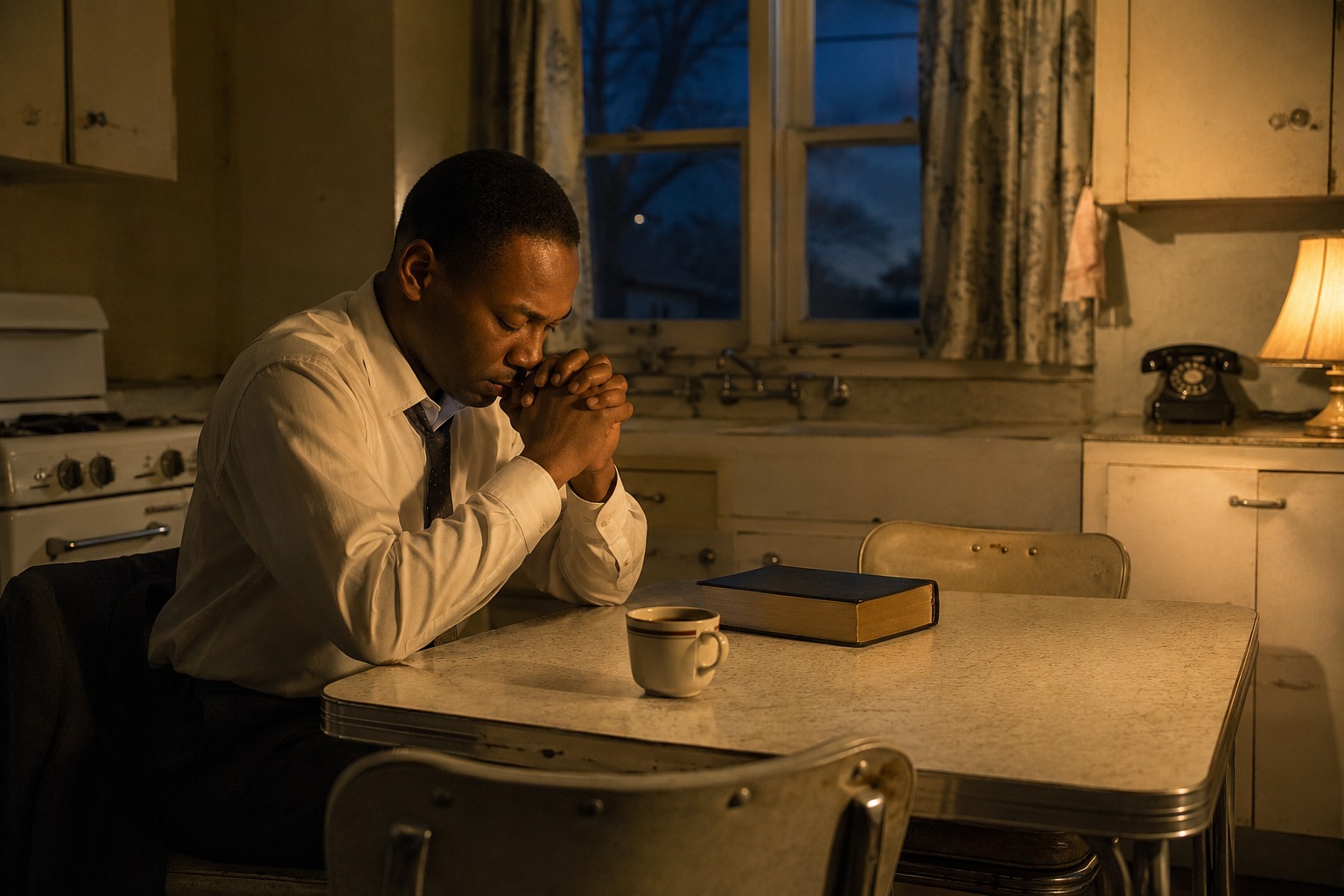 AI-generated historical reconstruction inspired by King’s account of praying alone at his kitchen table during the Montgomery Bus Boycott. It is an illustration, not an authentic image of the moment.
His circumstances had not changed. The boycott remained dangerous, and the threats had not stopped. What changed was King’s inner condition. He said his fear began to leave and he became ready to face what might come.
The inner voice belongs to King’s own spiritual testimony. What happened three nights later showed how deeply he trusted it.2
A Bomb and an Armed Crowd
On the evening of 30 January 1956, King was speaking at a mass meeting when a bomb exploded on the front porch of his home.
Coretta Scott King was inside with a friend and the Kings’ infant daughter, Yolanda. The blast damaged the porch and shattered windows, but none of them was injured.
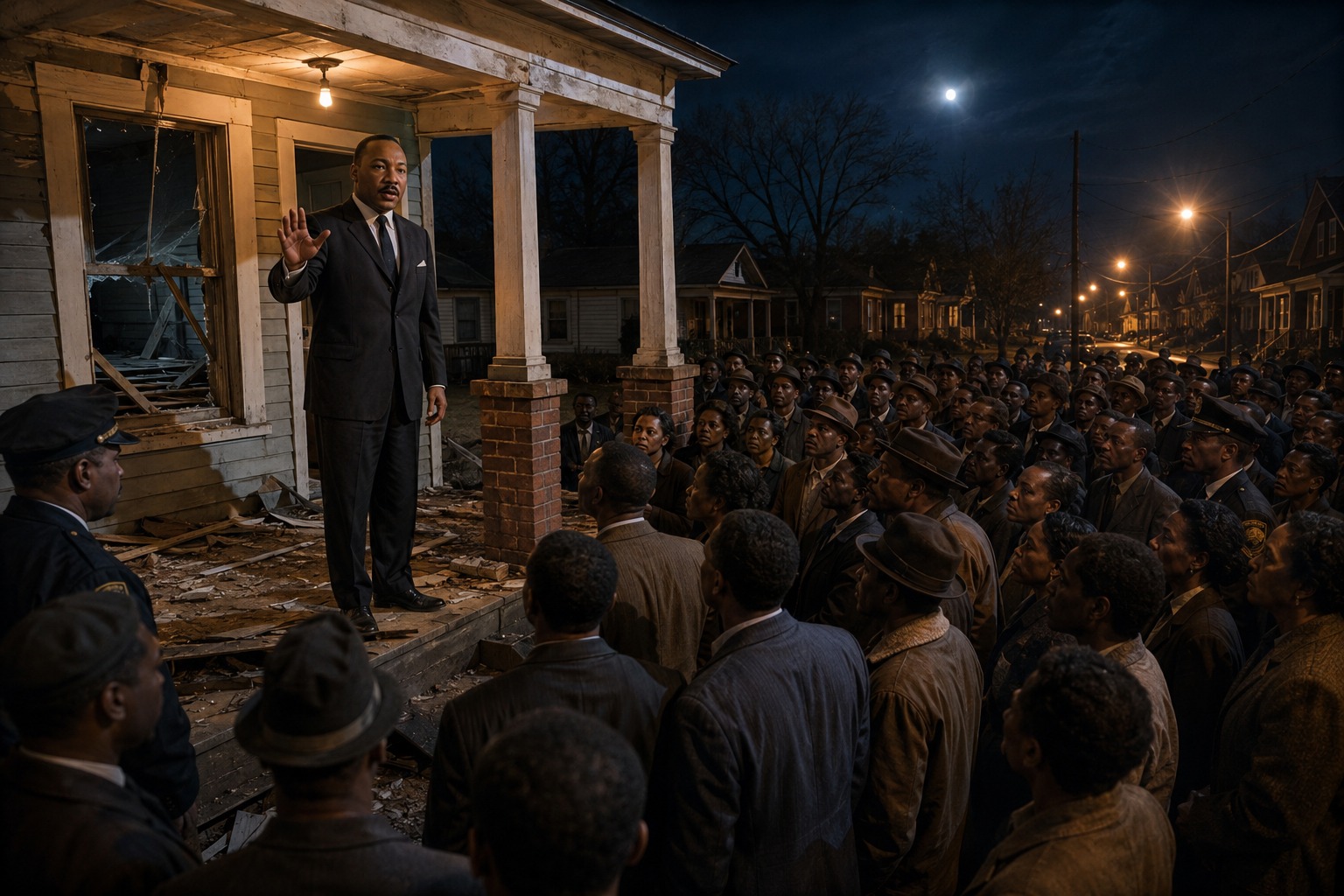 AI-generated historical reconstruction of King appealing for calm outside his bomb-damaged home on 30 January 1956. It is an illustration, not an authentic image of the event.
King hurried home. Hundreds of angry people had gathered outside, and some were carrying weapons. Police officers were struggling to control the crowd. The bombing could easily have transformed a nonviolent protest into a night of bloodshed.
After making sure that his wife and child were safe, King stepped onto the damaged porch. He raised his hand, and the crowd became quiet.
“We are not advocating violence. We want to love our enemies.”
He asked the people to put away their weapons, go home peacefully and continue the struggle without retaliation. The crowd obeyed. People began singing hymns before dispersing.3
King later explained the foundation of the movement’s discipline in a single sentence:
“Christ furnished the spirit and motivation while Gandhi furnished the method.”
For King, nonviolence was not passive surrender. It resisted injustice without allowing hatred to govern the resister. The purpose was not to humiliate an opponent but to end the wrong and make reconciliation possible.4
That conviction was tested again and again.
The Blade Beside His Heart
On 20 September 1958, King was signing copies of his book Stride Toward Freedom in a Harlem department store. A woman named Izola Ware Curry approached him and plunged a steel letter opener into his chest.
The blade lodged dangerously close to his aorta. Doctors later explained that a sneeze or cough could have caused it to pierce the artery and kill him. Surgeons worked for more than two hours to remove it.
When King learned that Curry was seriously mentally ill, he did not ask for vengeance. After returning to Montgomery, he expressed sympathy for her and said:
“I bear no bitterness toward her.”
He hoped that she would receive the treatment she needed.5
King’s response did not minimise the violence committed against him. It showed the demanding meaning he gave to nonviolence: opposing the wrong while refusing to surrender the human worth of the person who had done it.
During his recovery, letters arrived from across the country. One came from a white high-school student who had read that he would have died if he had sneezed. Ten years later, on the final night of his life, King still remembered her simple words.6
Long Thoughts and Prayers in Birmingham Jail
By 1963, King and the Southern Christian Leadership Conference had joined local leaders, including the Reverend Fred Shuttlesworth, in a campaign against segregation in Birmingham, Alabama.
On Good Friday, 12 April, King and Ralph Abernathy marched despite a court injunction and were arrested. King was placed in a narrow cell and initially denied a telephone call to Coretta, who was at home recovering from the birth of their fourth child.
Eight local religious leaders published a statement calling the demonstrations “unwise and untimely.” King found the statement in a newspaper and began writing a response along its margins. He continued on scraps supplied by a jail trustee and finished on writing pads left by his lawyers.
From the cell, he explained why people suffering injustice could not simply be asked to remain patient:
“This ‘Wait’ has almost always meant ‘Never.’”
He argued that nonviolent direct action was intended to create the urgency necessary for genuine negotiation. He drew upon the Bible, Christian conscience and the moral difference between just and unjust laws.
The letter travelled beyond the jail. It was copied, published and eventually read across the United States. Meanwhile, Birmingham’s Black residents continued the campaign. Schoolchildren and young people joined the marches. Images of police dogs and powerful fire hoses being used against demonstrators forced people far beyond Alabama to confront the brutality that protected segregation.
The movement belonged to far more than one leader. Courage came from children, parents, pastors, organisers, lawyers and ordinary workers who accepted danger together. King’s particular task was to give their struggle a moral language that the nation could no longer easily ignore.7
A Dream Spoken Before the Nation
Four months after Birmingham, on 28 August 1963, more than 250,000 people gathered in Washington for a march demanding jobs and freedom. It was a united movement organised through the work of A. Philip Randolph, Bayard Rustin and numerous civil-rights, religious and labour organisations.8
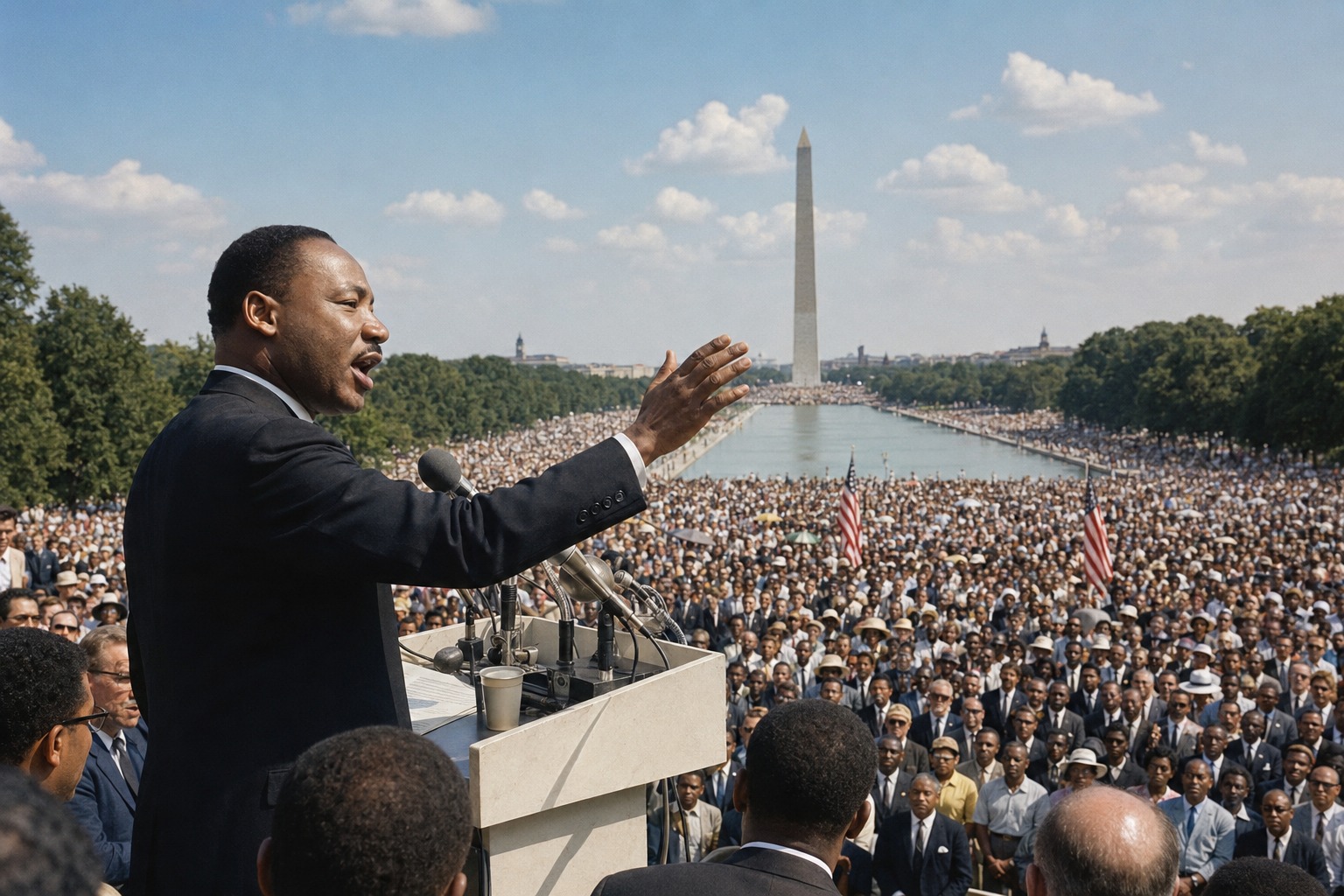 AI-generated historical reconstruction of King addressing the March on Washington for Jobs and Freedom on 28 August 1963. It is an illustration, not an authentic image of the speech.
Standing before the Lincoln Memorial, King spoke about America’s unfulfilled promise of equality. He did not ask the nation to forget segregation, police brutality or restricted opportunity. He named these injustices clearly, but refused to allow the hatred of the present to determine the shape of the future.
His most personal image concerned his four young children. He dreamed that they would one day live in a nation where they would:
“…not be judged by the color of their skin but by the content of their character.”
King widened that dream to include the descendants of enslaved people and slaveholders sitting together, Black and white children joining hands, and freedom reaching every part of the country.9
The movement’s sustained work helped build the public pressure that accompanied the Civil Rights Act of 1964 and the Voting Rights Act of 1965.1415
The Prize He Did Not Keep
In December 1964, thirty-five-year-old Martin Luther King Jr. received the Nobel Peace Prize in Oslo.
He did not accept it as the achievement of one famous man. He received it in the name of the thousands participating in what he called a “mighty army of love.”
The prize included $54,000. King shared the entire monetary award among civil-rights organisations, including the Gandhi Society for Human Rights, the Southern Christian Leadership Conference, the NAACP, the Student Nonviolent Coordinating Committee and other groups.1011
The honour returned to the movement from which it had come. Recognition became another resource for the work.
The Workers Who Carried “I AM A MAN”
King’s work gradually extended beyond racial segregation to poverty, labour rights and opposition to war.
In February 1968, Memphis sanitation workers Echol Cole and Robert Walker were crushed to death by a malfunctioning garbage truck. Their deaths came after years of unsafe working conditions, low wages and unequal treatment. About 1,300 Black sanitation workers went on strike, seeking union recognition, safer equipment and a decent wage. During their marches, they carried signs declaring: “I AM A MAN.”
King saw their struggle as part of a larger campaign for economic justice. A march he led on 28 March descended into violence, and he was deeply troubled. Some colleagues advised him not to return immediately. King went back because he believed the nonviolent movement in Memphis had to be restored and the workers could not be abandoned.
On 3 April, a storm swept through the city. King was exhausted, had a sore throat and a slight fever, and initially remained at the Lorraine Motel. When he learned that people had gathered at Mason Temple hoping to hear him, he went through the rain to speak.12
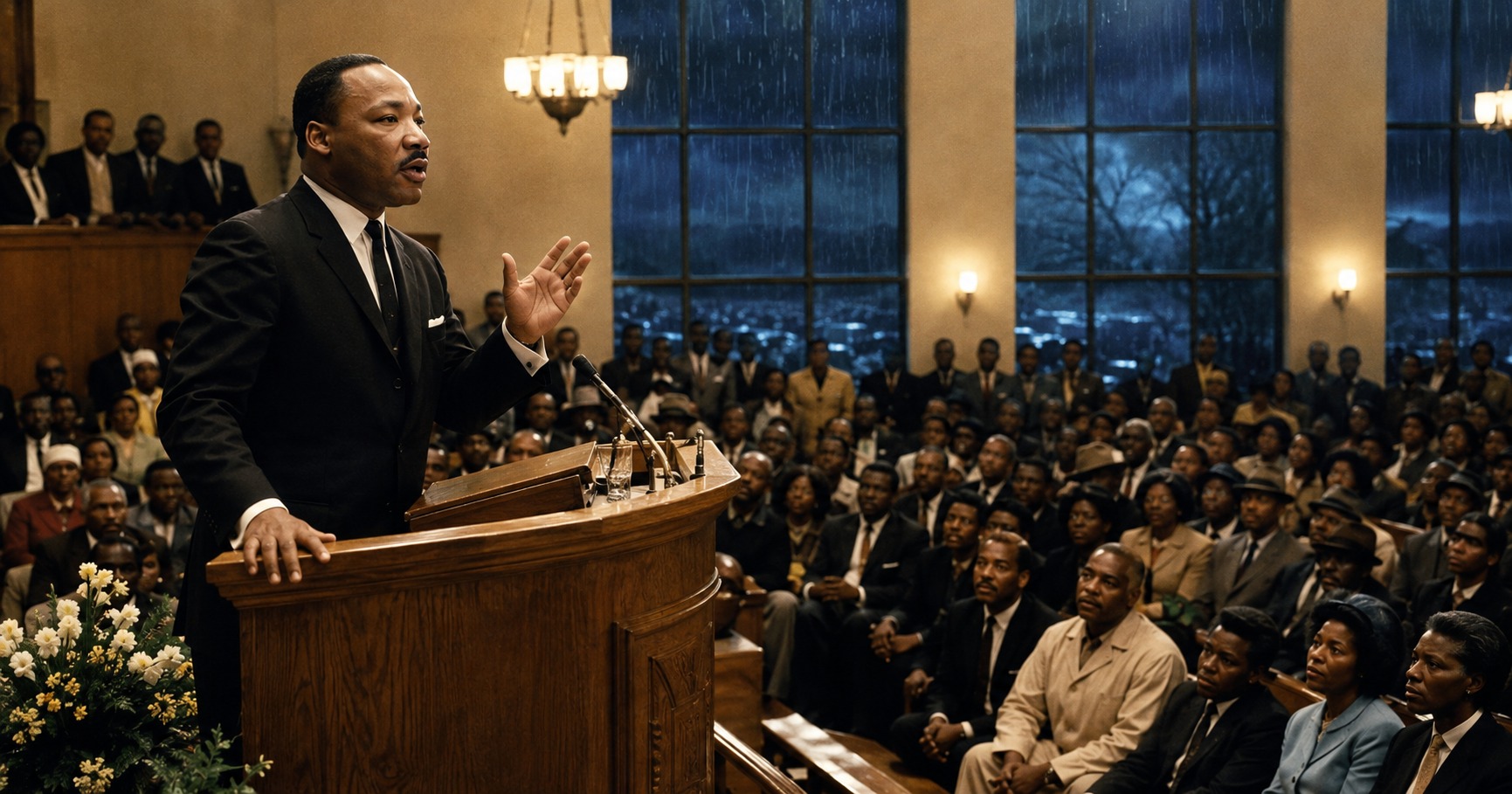 AI-generated historical reconstruction inspired by King’s final “Mountaintop” sermon at Mason Temple on 3 April 1968. It is an illustration, not an authentic image of the event.
Near the end, King remembered the stabbing ten years earlier. He recalled the student’s letter:
“I am so happy that you didn’t sneeze.”
Had he died in 1958, he said, he would not have witnessed the student sit-ins, the Freedom Rides, Birmingham, the March on Washington or Selma. His survival had given him more years in which to serve.
Then his words turned towards the uncertain future. He spoke of having seen the Promised Land and told the crowd:
“I may not get there with you.”
Less than twenty-four hours later, on 4 April 1968, King was shot on the balcony of the Lorraine Motel and died at the age of thirty-nine.
Four days later, Coretta Scott King joined sanitation workers and civil-rights leaders in a silent march through Memphis. On 16 April, an agreement was reached that recognised the workers’ union and provided better wages.1213
King did not live to see the conclusion of the cause that had brought him to Memphis. The workers continued walking.
DataTorch Closing Thought
Martin Luther King Jr.’s faith did not remove danger from his path. After the kitchen-table prayer came the bombing. After his commitment to nonviolence came arrest and a blade beside his heart. After the Nobel Prize came further struggle, exhaustion and death.
Faith did something different. It gave him the inner strength to keep acting without allowing fear or hatred to decide what kind of person he would become.
The most revealing moment in King’s life may not have been before the vast crowd in Washington. It may have been the unseen moment when a frightened young pastor bowed over a kitchen table, admitted that his own strength was finished and rose believing that God had asked him to continue.
His courage then became action: calming an armed crowd, forgiving an attacker, writing from a jail cell, giving away a prize and returning to stand beside workers whom society had treated as less than men.
He could not control what hatred would do to him. He could decide what faith, conscience and love would do through him.