Harriet Tubman and the Combahee River Raid: Turning War into Freedom
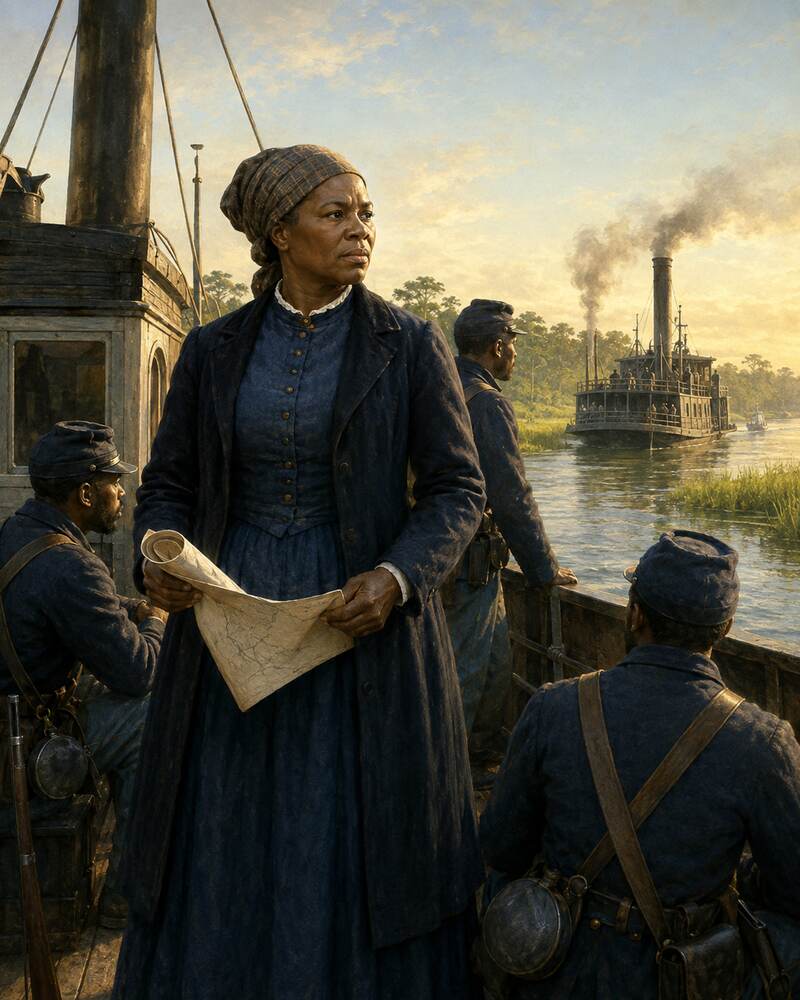 AI-generated historical reconstruction of Harriet Tubman helping guide the Combahee River expedition at dawn. It is an illustration, not an authentic image of the event.
“God won’t let Master Lincoln beat the South till he does the right thing,” Harriet Tubman later said.
To Tubman, the “right thing” was setting enslaved people free. Her words were not recorded as advice delivered personally to Abraham Lincoln. They were preserved in Sarah Bradford’s account of Tubman’s life. Nevertheless, they reveal her firm conviction that the Union could not truly overcome the rebellion while leaving slavery untouched.8
Tubman did not wait for political leaders to complete that work. When the American Civil War offered an opportunity to attack slavery on a much larger scale, she entered the conflict herself.
A Nurse Who Knew More Than Medicine
In May 1862, Tubman travelled to the Union-controlled region around Beaufort and Port Royal in South Carolina. Thousands of formerly enslaved people had gathered there after plantation owners and Confederate forces withdrew from the coastal islands.
Disease, hunger and overcrowding were common. Tubman served as a nurse, cook and laundress, caring for Black soldiers and formerly enslaved families. She also used her knowledge of plants and traditional remedies while working among the sick.3
Military officers soon recognised that she possessed another kind of experience. During her journeys on the Underground Railroad, Tubman had learned to travel secretly, recognise danger, win people’s confidence and make decisions without waiting for complete certainty.
Those abilities made her valuable as a scout and intelligence organiser. A surviving military record from January 1863 authorised one hundred dollars in “secret service money” for her work. She began assisting Union operations beyond the hospital camps.4
The Combahee River passed through some of South Carolina’s richest rice-growing country. Its plantations supplied wealth and food to the Confederacy. Confederate forces had also placed underwater explosives—then called torpedoes—in parts of the river.
Tubman worked with Black scouts, pilots and freedom seekers who knew the waterways, tides, plantation roads and Confederate positions. Their information helped identify the locations of explosives and military defences. Tubman brought this knowledge together and helped Union officers prepare an expedition into the area.1
Three Steamships in the Darkness
On the evening of 1 June 1863, three Union steamships left Beaufort. They carried Harriet Tubman, Colonel James Montgomery, Black soldiers of the 2nd South Carolina Volunteers and supporting artillerymen.
The vessels were the John Adams, the Harriet A. Weed and the Sentinel.
They travelled through the darkness towards the Combahee River. Before reaching the destination, the Sentinel ran aground. Its soldiers transferred to another vessel, and the expedition continued.
Tubman’s intelligence helped the remaining ships pass Confederate defences and underwater explosives. Early on 2 June, the vessels entered the river. Soldiers landed at strategic points while Confederate troops withdrew or were driven back.
Union forces destroyed bridges, rice mills, plantation buildings and supplies supporting the Confederate war effort. But the expedition’s greatest purpose went beyond damaging property. The steamships had come to carry people out of slavery.
Under Montgomery’s military command, Tubman helped plan and lead what the Smithsonian describes as the first major United States military operation led by a woman.5
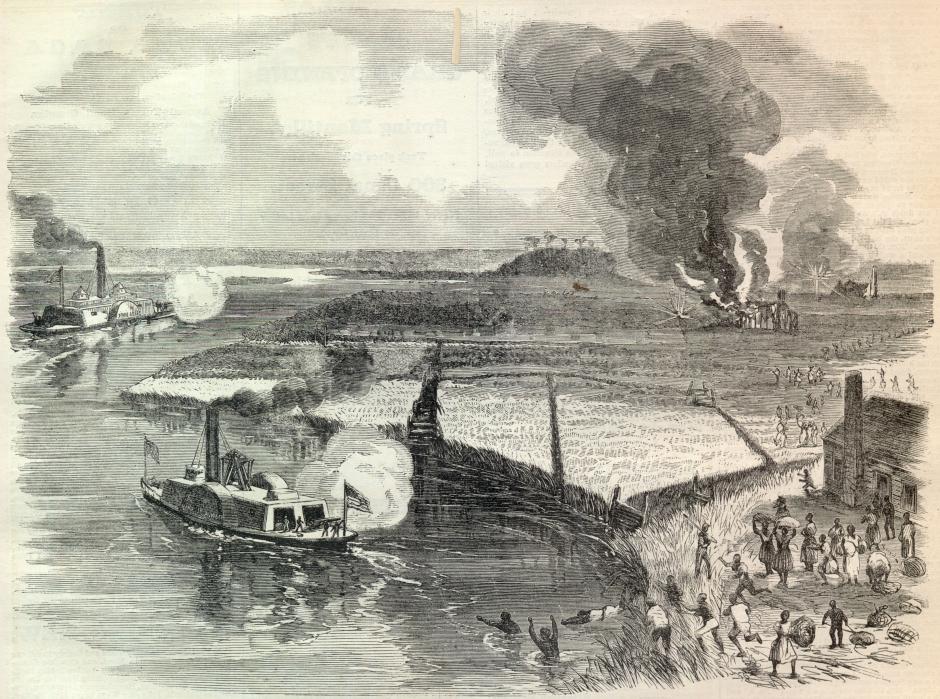 Raid of Second South Carolina Volunteers among the Rice Plantations on the Combahee, published in Harper’s Weekly, 4 July 1863. The anonymous illustration is a contemporary representation of the raid. Public domain.
When the Steam Whistles Sounded
The steamships sounded their whistles as they moved along the river.
Enslaved families on the surrounding plantations gradually understood what was happening. The soldiers arriving on the boats were Black Union soldiers, and they had not come to return anyone to slavery.
People began running from the rice fields, cabins and plantation grounds towards the river. Overseers attempted to stop them, but the movement became too large.
Tubman later remembered women carrying children, baskets and whatever possessions they could manage. Some brought pigs and chickens. Families crowded towards the small boats sent ashore to collect them.
Many were initially frightened and uncertain. According to the account preserved by Sarah Bradford, Tubman sang to reassure them and encourage them to come aboard. The woman who had used spirituals during secret journeys was once again using song to call people towards freedom.8
The decks soon filled with men, women and children. These families were not passive passengers waiting to be rescued. When the opportunity appeared, they left the plantations, ran towards the river and claimed their freedom.
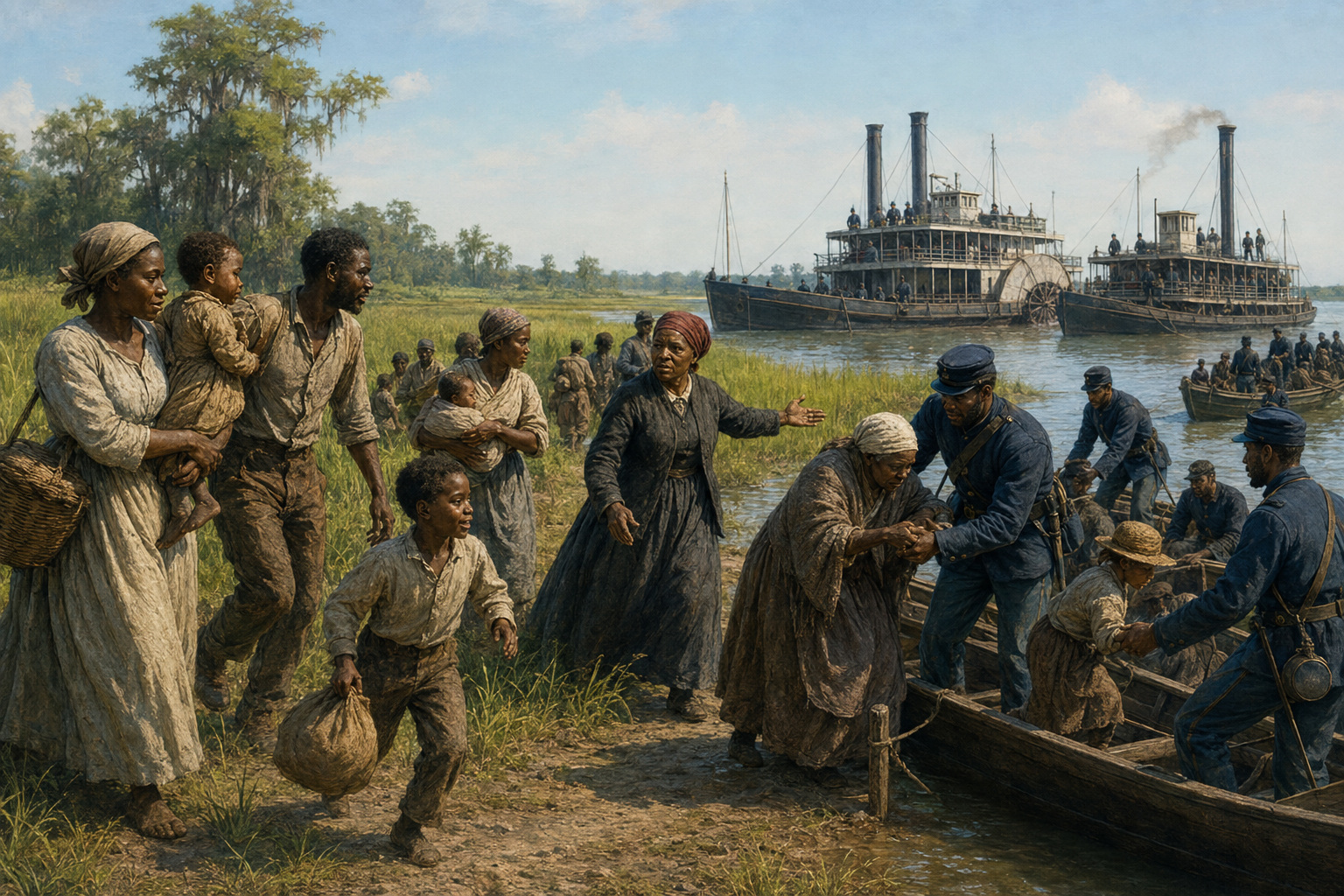 AI-generated historical reconstruction of Black families approaching Union boats during the Combahee River Raid. It is an illustration based on documented events, not an authentic image of the people shown.
More Than Seven Hundred People Break Free
By the end of the operation, more than 700 enslaved people had escaped from the plantations along the Combahee River. Some official accounts place the number at approximately 750.23
The vessels returned to the Union-controlled area near Beaufort on 3 June. During the following days, Tubman helped recruit more than 150 of the newly freed men into the 2nd South Carolina Volunteers.1
The raid liberated families, weakened plantations supplying the Confederacy and strengthened the Union Army with men now prepared to fight against the system that had enslaved them.
The Emancipation Proclamation had taken effect five months earlier. It declared enslaved people in the states still in rebellion to be free. But a written proclamation could not immediately reach every plantation.
At Combahee, Union military power, the courage of Black soldiers, intelligence from freedom seekers and Tubman’s leadership carried emancipation into territory still controlled by enslavers.2
Tubman’s Role in the Abolition of Slavery
Harriet Tubman did not draft the Emancipation Proclamation or the Thirteenth Amendment, which finally abolished slavery throughout the United States. There is also no evidence that Lincoln adopted emancipation because of Tubman’s reported words about doing “the right thing.”
Her role in abolition was nevertheless considerable.
Before the Civil War, she had personally guided approximately seventy people out of slavery and provided instructions that helped many others escape. She worked with abolitionists such as Thomas Garrett, William Still and Frederick Douglass, turning the Underground Railroad from an ideal into a path that real families could travel. Her earlier escape and rescue missions are told in Harriet Tubman: Guided by Faith on the Road to Freedom.
During the war, she carried the same work into Union service. She gathered intelligence, organised scouts, supported Black military recruitment and helped lead an operation that freed more than 700 people at one time.
Tubman therefore contributed to abolition in the most direct possible manner: she repeatedly removed human beings from the control of enslavers. She also demonstrated that formerly enslaved people were not merely waiting for freedom to be granted. They were gathering intelligence, guiding armies, joining Black regiments and actively destroying the institution that had held them.
Lincoln’s proclamation changed the purpose and legal direction of the war. Congress and the states later abolished slavery nationally through the Thirteenth Amendment. Tubman’s distinctive contribution was to help transform abolition from a political promise into freedom experienced by individuals and families.7
Faith That Became Direction
Throughout her dangerous journeys, Tubman understood her faith as a source of direction. The dreams and visions that followed her childhood head injury continued into adulthood, and she regarded some of them as divine warnings or promptings. She spoke naturally of “consulting with God” before making difficult decisions.
Thomas Garrett, who assisted her Underground Railroad missions, wrote:
“I never met with any person of any color who had more confidence in the voice of God, as spoken direct to her soul.”
Her faith also had a practical place in her work. Tubman used spirituals such as Go Down Moses and altered songs to signal whether it was safe to approach or whether danger was nearby.6
In a dictated letter, she expressed her understanding of freedom:
“God set the North Star in the heavens; He gave me the strength in my limbs; He meant I should be free.”
For Tubman, trusting God did not mean waiting without action. She prayed, watched carefully, listened to others, planned her journeys and moved forward despite danger. The same relationship between faith and action remained visible in her Civil War service and at the Combahee River.
DataTorch Closing Thought
Harriet Tubman did not abolish slavery through legislation. Her contribution was more direct: she entered dangerous territory, guided people out of bondage, gathered intelligence and helped carry freedom to hundreds along the Combahee River.
Her conviction focused her mind, her trust in God steadied her spirit, and her body acted despite danger and weakness. Tubman believed that God intended people to be free—and she devoted her life to making that freedom visible in the lives of others.