St Thérèse of Lisieux: The Little Way of Trust and Love
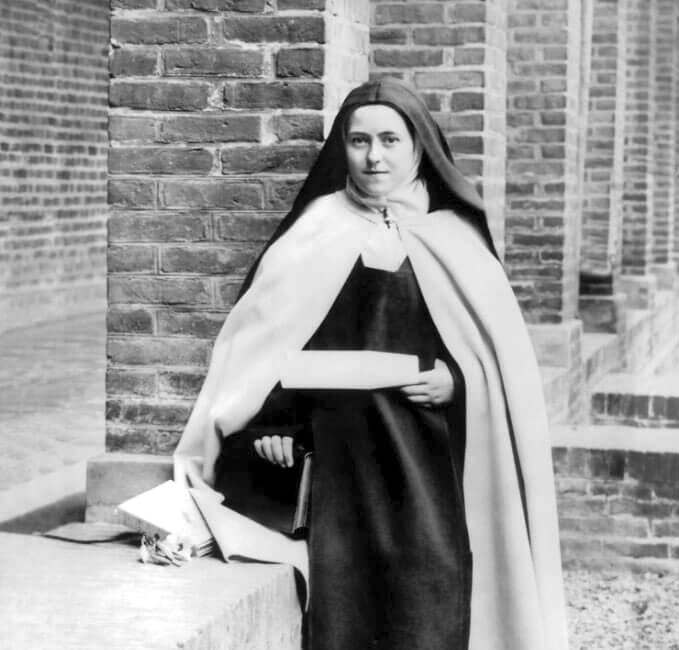 St Thérèse of Lisieux in the courtyard of the Carmel of Lisieux, 1896. Photograph by her sister Céline Martin. Public domain.
A Prisoner She Would Not Abandon
In 1887, newspapers across France were reporting the case of Henri Pranzini, who had been convicted of murdering three people in Paris and sentenced to death.
Pranzini was reported to be unrepentant. Fourteen-year-old Thérèse Martin became deeply concerned about him. She prayed for his conversion and arranged for a Mass to be offered for him.
Thérèse trusted that God could forgive Pranzini even if no outward sign of repentance appeared. Nevertheless, because this was the first person for whom she had prayed with such urgency, she asked God for a sign that her prayer had been heard.
Pranzini was executed on 31 August 1887. Thérèse later read a newspaper report stating that, shortly before his death, he turned towards a priest, took the crucifix being offered to him and kissed its wounds three times.1
Thérèse regarded this action as the sign she had requested. History cannot establish what happened within Pranzini’s conscience, but the incident strengthened her conviction that no person should be abandoned as beyond the mercy of God. She later referred to Pranzini as her first spiritual child.
The Door She Kept Knocking On
Thérèse wanted to enter the Carmelite convent in Lisieux, where her older sisters Pauline and Marie were already living. Church authorities, however, considered her too young.
She appealed to the Carmelite superior and then to the Bishop of Bayeux. When permission still did not come, she travelled to Italy in 1887 with her father, Louis Martin, and her sister Céline as part of a diocesan pilgrimage.
During an audience with Pope Leo XIII on 20 November, the pilgrims had been instructed not to speak. Thérèse nevertheless knelt before the Pope and personally asked him to allow her to enter Carmel at fifteen.
Pope Leo did not overrule the authorities responsible for the decision. He told her to follow their direction and assured her that she would enter if it were God’s will. Thérèse continued speaking until the guards led her away.
Permission was eventually granted. On 9 April 1888, at the age of fifteen, Thérèse entered the Carmel of Lisieux.4
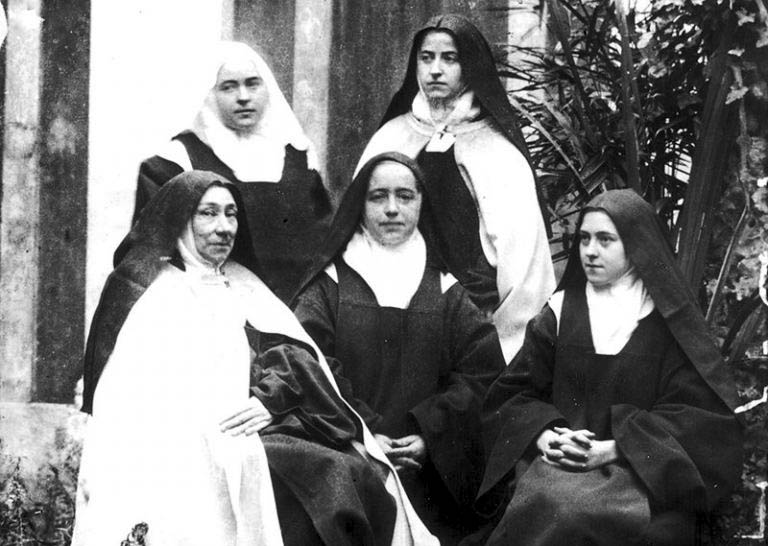 Members of the Carmel of Lisieux community, about 1894–1895. Thérèse is seated at the right; her sisters Céline and Pauline are standing. Photograph by Céline Martin. Public domain.
Life inside the convent was very different from the missionary adventures she had sometimes imagined. Her days were spent in prayer, silence, community life and ordinary duties. She served at different times in the sacristy, the laundry and the refectory, and later helped guide the younger novices.
A Lift Instead of a Staircase
Thérèse wanted to become a saint, but she felt small when she compared herself with the great saints. She compared them to high mountains and herself to a grain of sand beneath the feet of passers-by.
Instead of abandoning her desire, she searched for a path suited to someone conscious of her weakness.
Thérèse lived at a time when mechanical lifts were beginning to replace staircases in larger buildings. She used this new invention to explain what she was seeking. She felt unable to climb what she called the difficult stairway of perfection and wanted to find a lift that would raise her to God.
She searched Scripture and found an invitation in the Book of Proverbs addressed to the little ones. In Isaiah, she read of God carrying and comforting his children as a mother carries and comforts a child.
Thérèse concluded that the arms of Jesus would be the lift that raised her. She would make every effort she could, but she would not depend upon her own achievements or consider holiness a reward earned by impressive deeds.
This understanding became known as her Little Way—the way of spiritual childhood, trust and love.2
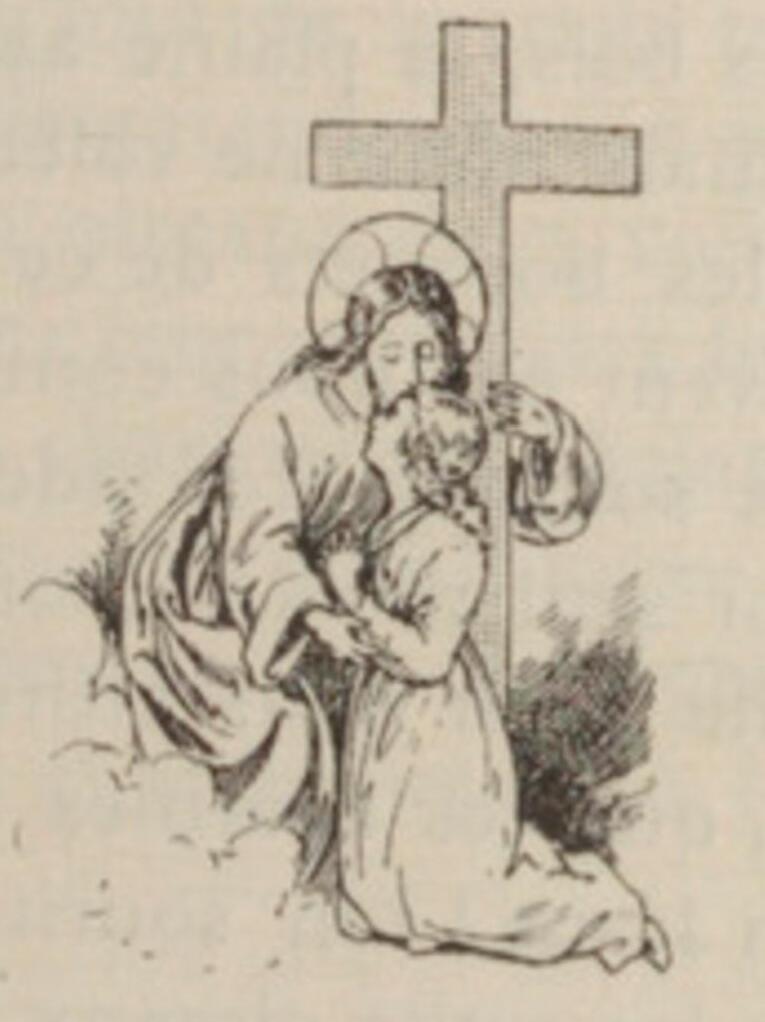 An illustration reproduced in the 1912 edition of Story of a Soul, expressing the trust of spiritual childhood. Public domain.
Helping an Infirm Sister
In Carmel, Thérèse was assigned to help an elderly, infirm sister walk from the chapel to the refectory. The sister was difficult to please and complained if Thérèse did not assist her exactly as she expected.
One cold winter evening, Thérèse heard music from a celebration outside the convent while she was guiding the sister through the dark cloister. She later wrote that she would not have exchanged those few minutes of service for years of worldly enjoyment.2
For Thérèse, helping a difficult person patiently was one way of living the Little Way.
Finding Her Vocation
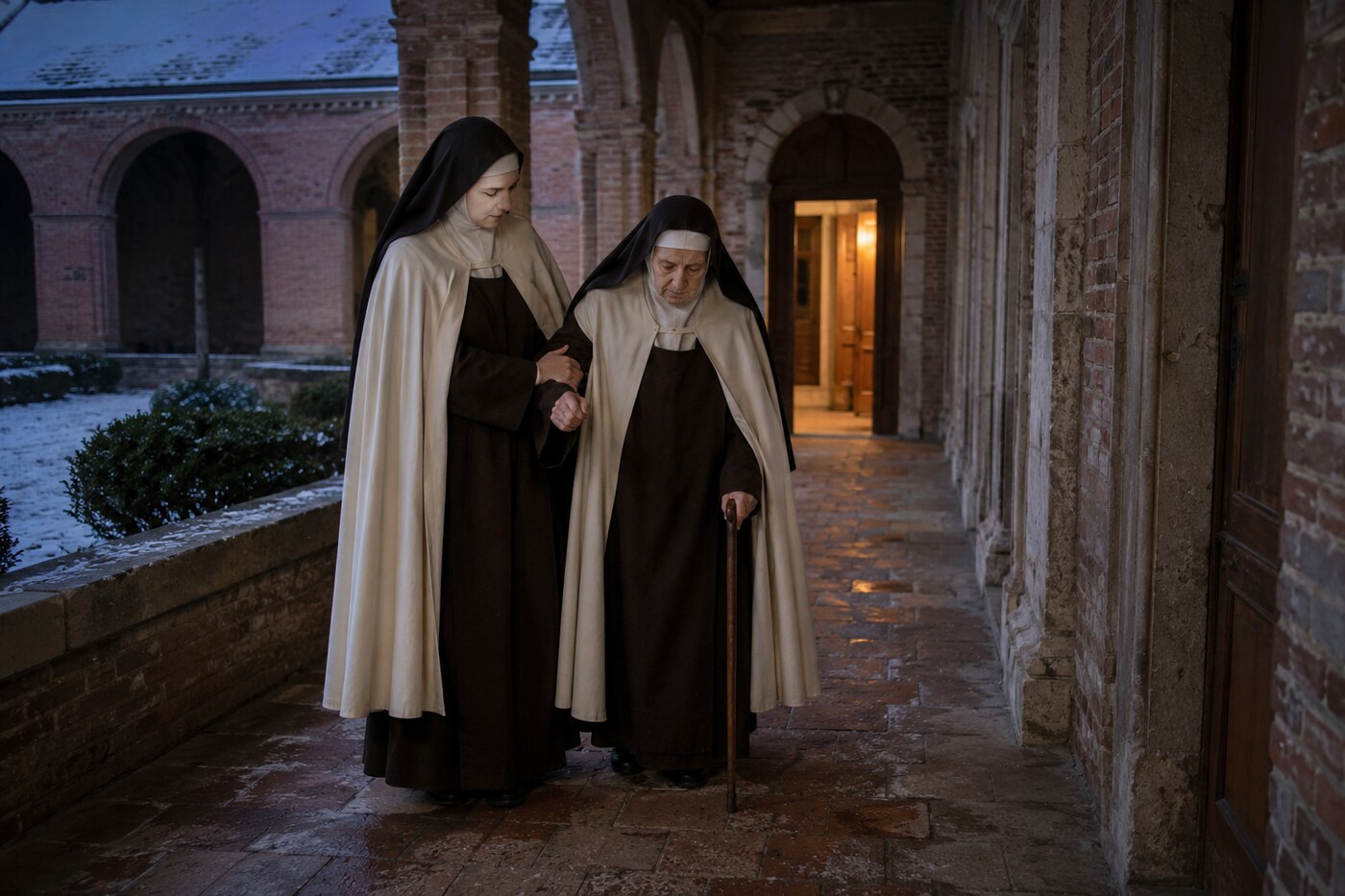 AI-generated historical reconstruction of Thérèse helping an infirm Carmelite sister. It is an illustration, not an authentic photograph of the event.
Thérèse had many desires. She wanted to become a missionary, a priest, an apostle, a martyr and a teacher. Within the enclosure of Carmel, however, she could not undertake most of the activities she imagined.
She turned to St Paul’s First Letter to the Corinthians, where the Church is described as one body with many different members. But she still could not identify herself with only one particular role.
She continued reading and reached St Paul’s teaching about love. She understood that love gave life to every vocation and every work of the Church.
From within the convent, she prayed for missionaries and corresponded with two missionary priests who were entrusted to her spiritual support. She offered her daily work, sacrifices and suffering for the Church and for people she would never meet.2
Faith Without Consolation
Thérèse’s Little Way did not free her from suffering.
Her father developed a serious mental illness and spent periods in an institution. Watching the decline of the father she loved caused Thérèse and her sisters great pain.
During the night between Holy Thursday and Good Friday in April 1896, Thérèse coughed up blood. It was the first clear sign of the tuberculosis that would take her life.
As her health declined, she also entered what she described as a trial against faith. The consolation she had once received from thinking about heaven disappeared. Instead, she experienced darkness and powerful doubts.
Thérèse did not conceal this experience. She wrote that when she sang about the happiness of heaven, she sometimes did so not because she felt its joy but because she chose to believe.
She also felt a new closeness to people who could not believe. She described herself as sharing their table of darkness and continued praying for them.
Her illness became progressively worse. She was moved to the convent infirmary in July 1897 and died from tuberculosis on 30 September 1897. She was twenty-four years old and had spent nine years in Carmel.3
The Making of Story of a Soul
Thérèse did not sit down intending to write a famous book. At the request of her Carmelite superiors, she wrote three autobiographical manuscripts between 1895 and 1897.
The first manuscript recalls her childhood, family life, religious development, desire to enter Carmel and early convent years. The second contains her wide spiritual ambitions and her discovery that her vocation within the Church was love. The third explains the Little Way more fully and describes charity within community life, her trial of faith and her approaching death.
Her writings are not merely a record of dates and events. They reveal how she understood her experiences, weaknesses, relationships, prayer, suffering and trust in God’s mercy.
The three manuscripts were arranged and published after her death under the title Story of a Soul. Although it was initially intended mainly for Carmelite communities and a limited circle of readers, the book quickly became widely known and was translated into many languages.3
The Little Way—Point by Point
Thérèse did not publish the Little Way as a formal numbered programme. However, its principal elements can be stated clearly:
- Recognise your littleness. Accept honestly that you have weaknesses, limitations and faults. Do not pretend to possess strength that you do not have.
- Trust the mercy of God. Place your confidence in God’s love rather than in your merits, achievements or spiritual success.
- Perform ordinary duties with love. Holiness can grow through daily work, patience, kindness, prayer and service—especially when these actions remain unnoticed.
- Begin again after failure. Do not allow a mistake or weakness to become a reason for despair. Acknowledge it, seek forgiveness, rise and continue.
- Love people who are difficult to love. Genuine charity is shown not only through affection for friends but also through patience with people who irritate, disappoint or misunderstand us.
- Live in the present moment. Do not carry imagined future suffering before it arrives. Attend faithfully to the duty and opportunity for love placed before you today.
- Offer small actions for the good of others. An act may appear insignificant, but it can become meaningful when it is performed with love and offered for another person.
- Surrender what you cannot control. Make the effort that is possible, then entrust the result to God rather than becoming consumed by fear and anxiety.
The Little Way Leaves the Cloister
Story of a Soul carried Thérèse’s message far beyond the convent she had never left.
She was canonised by Pope Pius XI in 1925. Two years later, she was proclaimed a patroness of the missions alongside St Francis Xavier, although she had never travelled to a mission country.
In 1997, Pope John Paul II proclaimed her a Doctor of the Church, recognising the importance of the spiritual teaching developed during her brief life. Pope Francis later described the Little Way as a path of trust and love that anyone can follow, whatever their age or situation.23
Near the end of her life, as illness and spiritual darkness surrounded her, Thérèse expressed the foundation of that way in a few words: “I count only on love.”
DataTorch Closing Thought
We may not be able to accomplish everything we desire, but every day gives us an opportunity to trust, begin again and place love within the duty before us. No act performed with sincere love is too small to have meaning.
Sources
- St Thérèse of Lisieux, Story of a Soul, Autobiographical Manuscript A, especially the Pranzini account. The modern manuscript references were checked against the Institute of Carmelite Studies edition cited in the Vatican documents below.
- Pope Francis, C’est la confiance, Apostolic Exhortation on confidence in the merciful love of God, 15 October 2023.
- Pope St John Paul II, Divini Amoris Scientia, declaring St Thérèse a Doctor of the Universal Church, 19 October 1997.
- Pope Benedict XVI, General Audience on St Thérèse of Lisieux, 6 April 2011.
- Sanctuary of Lisieux: The Story of Thérèse, official biographical chronology.
- St Thérèse of Lisieux, Story of a Soul, public-domain historical English edition, consulted for the narrative sequence and historical contents.