St. Jude Thaddeus: Stories of Hope When the Way Seemed Impossible
A Promise Made in Desperation
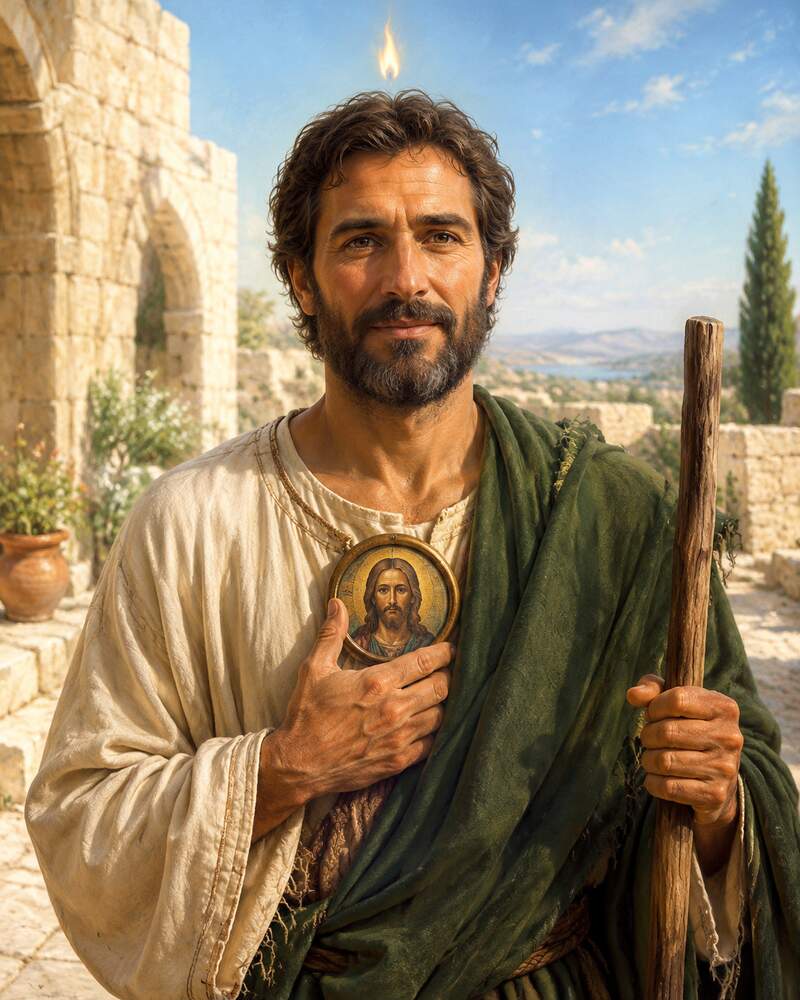 AI-generated devotional reconstruction of St. Jude Thaddeus, shown with the traditional image of Christ and the flame of Pentecost. It is an illustration, not an authentic portrait.
Long before the name St. Jude appeared on a children’s hospital, Danny Thomas was a young entertainer struggling to support his family.
Work was uncertain. His wife was expecting a child, and Thomas had very little money. Unsure of his future, he entered a church and prayed to St. Jude Thaddeus, the Apostle whom Catholics had come to invoke in desperate circumstances.
Thomas made a promise:
“Help me find my way in life, and I will build you a shrine.”
His difficulties did not disappear immediately. Two years later, although he had found some work in Detroit, his career remained uncertain. He returned to church, repeated his prayer and renewed his promise.5
Gradually, opportunities opened. Thomas became successful in radio, television and film. Yet the promise made during his years of uncertainty remained with him.
What began as the prayer of a struggling entertainer would eventually become a hospital offering hope to children whose illnesses were once considered almost impossible to cure.
But who was the Apostle to whom Danny Thomas had prayed?
The Apostle Who Shared a Name with the Betrayer
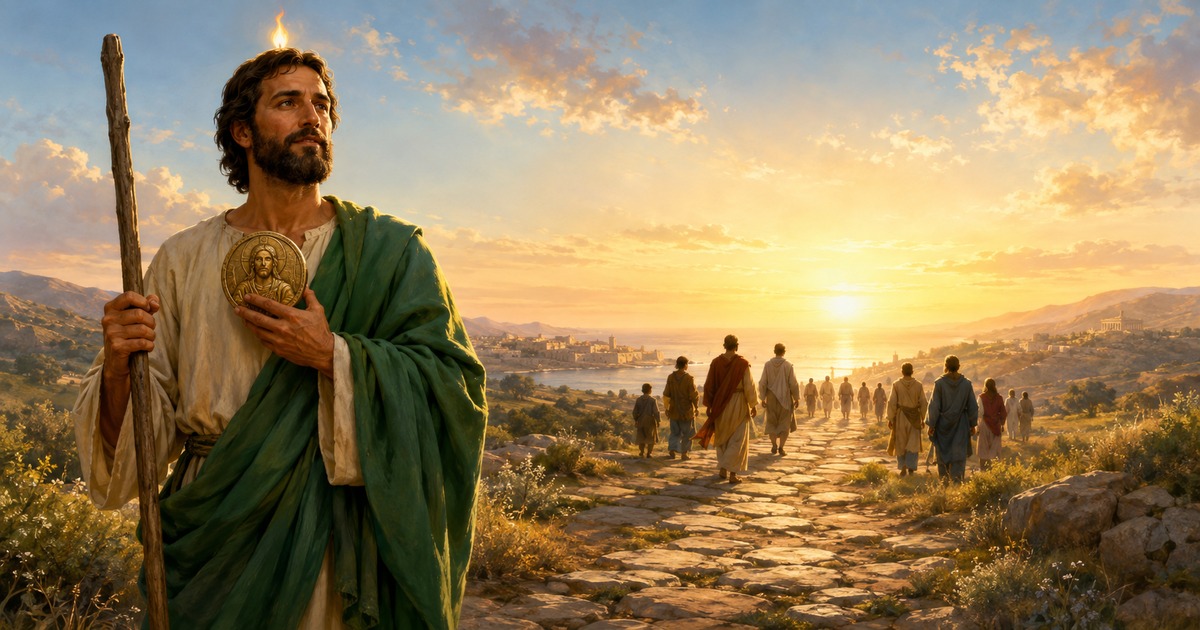 AI-generated historical reconstruction inspired by traditions of
St. Jude’s missionary journeys after Pentecost. It is an illustration,
not an authentic image of a particular event.
AI-generated historical reconstruction inspired by traditions of
St. Jude’s missionary journeys after Pentecost. It is an illustration,
not an authentic image of a particular event.
Jude Thaddeus was one of the Twelve Apostles chosen by Jesus. The Gospels distinguish him from Judas Iscariot, the disciple who betrayed Christ. Pope Benedict XVI observed that very little biographical information about Jude survives.1
The Gospel of John preserves one brief but revealing question from him. During the Last Supper, Jude asked Jesus:
“Master, then what happened that you will reveal yourself to us and not to the world?”
Jesus answered by speaking about love, obedience and God dwelling within those who receive him. Jude was trying to understand how Christ would make himself known after his visible departure.2
After the Resurrection and Pentecost, Jude disappears from the documented New Testament narrative. Later Christian traditions describe him preaching beyond Palestine, particularly in regions associated with Mesopotamia and Persia. These traditions also remember him suffering martyrdom while carrying out that mission, often together with the Apostle Simon.
The precise routes of his journeys and the circumstances of his death cannot now be established with certainty. What remained was the Church’s memory of an Apostle who followed Christ and continued preaching despite danger.
A Letter for People in Danger of Losing Their Way
The New Testament also contains a short letter traditionally attributed to Jude.
It addresses Christians whose faith was being disturbed by teachers whom the author believed were leading people away from the truth. Jude warned them firmly, but he did not tell them simply to become angry or afraid.
He asked them to build themselves up in faith, pray in the Holy Spirit and remain in the love of God. He also told them to show mercy towards people who were wavering. The letter ends by directing attention towards God, who is able to keep people from falling.3
These words help explain why later generations found Jude especially meaningful during difficult times. His message was not that suffering would always disappear. It was that people should remain rooted in God’s love, continue praying and extend mercy even when confusion and danger surrounded them.
How the Forgotten Apostle Became the Patron of Impossible Causes
According to longstanding devotional tradition, relics associated with Jude were eventually taken to Rome and placed beneath St. Peter’s Basilica. Pilgrims came to pray at the place connected with the Apostle, and accounts of favours received through his intercession began to spread.4
Catholics do not understand the saints as replacing God. They ask the saints to pray with them and for them, while recognising that every grace ultimately comes from God.
Devotional tradition particularly associates St. Bridget of Sweden and St. Bernard of Clairvaux with renewed confidence in St. Jude. A revelation attributed to St. Bridget records Christ directing her to approach Jude confidently:
“In accordance with his surname, Thaddeus, the amiable or loving, he will show himself most willing to give help.”
Later accounts also connect St. Bernard with a profound devotion to Jude. Some devotional sources say that Bernard received a vision concerning the Apostle, while the better-known tradition remembers his lifelong veneration of a relic of St. Jude. The early source for a separate vision naming Jude “Patron Saint of the Impossible” has not been clearly identified.
Over time, Jude became widely known among Roman Catholics as the patron saint of desperate, hopeless or apparently impossible causes. People approached him when illness, addiction, unemployment, family breakdown or some other crisis had left them unable to see a way forward.
They did not always receive the outcome they requested. Yet many testified that prayer gave them courage, peace, direction or an unexpected opening where none had seemed possible.
When a Promise Became a Hospital
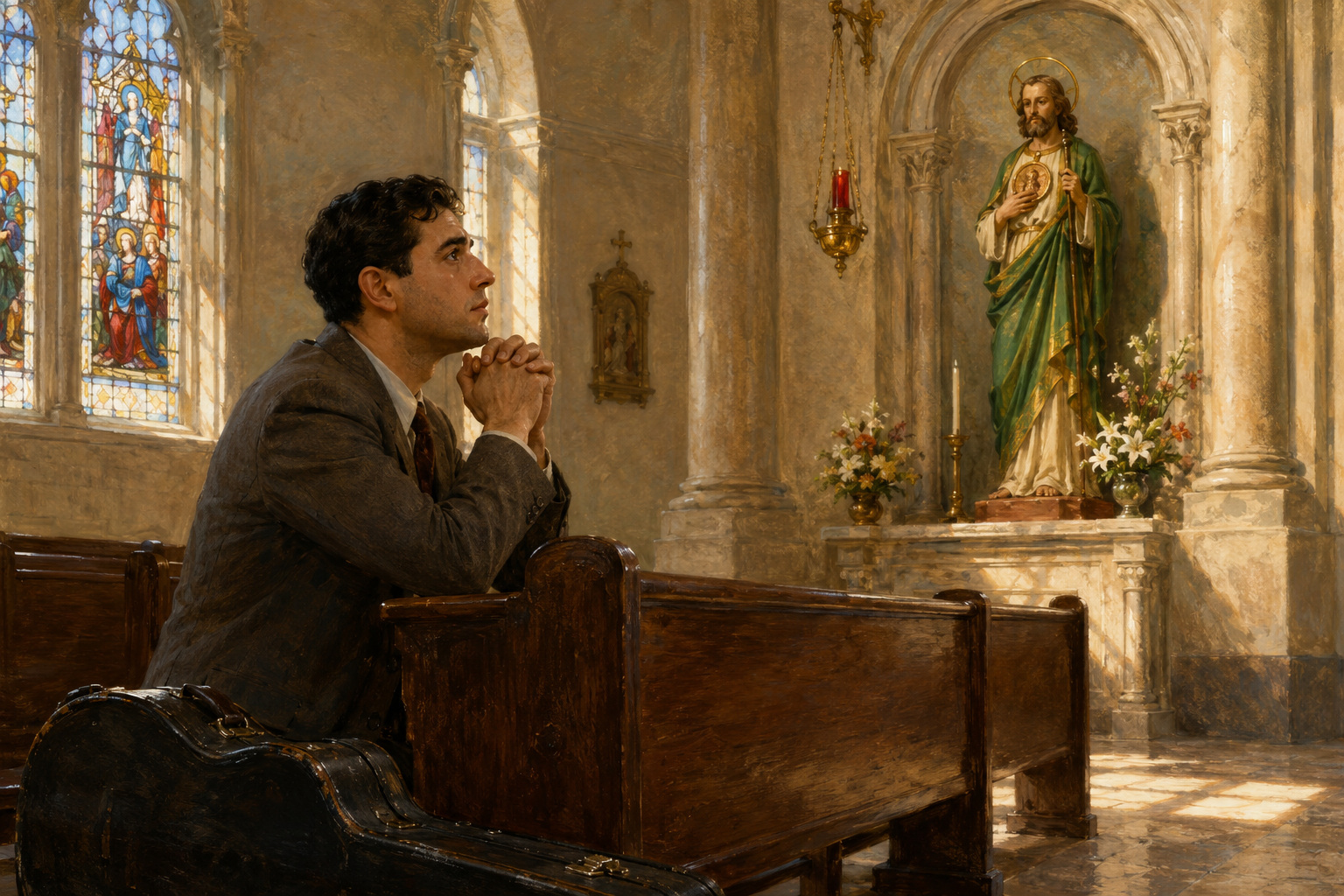 AI-generated historical reconstruction inspired by Danny Thomas’s account of praying to St. Jude during his early career. It is an illustration, not an authentic image of the moment.
Danny Thomas remembered the promise he had made.
By the early 1950s, he had become a well-known entertainer. He began asking friends, medical advisers and business leaders how his promised shrine to St. Jude could take practical form.
The answer gradually became clear: it would be a hospital for children suffering from catastrophic diseases.
Thomas and his wife, Rose Marie, travelled tirelessly to raise support. On one demanding journey, they visited twenty-eight cities in thirty-two days. Thomas also appealed to Americans of Arabic-speaking heritage, asking them to help create the hospital as an expression of gratitude for the opportunities their families had received in the United States.6
In 1957, one hundred representatives gathered in Chicago and formed ALSAC, the organisation that would raise money to build and sustain the hospital.
St. Jude Children’s Research Hospital opened in Memphis on 4 February 1962. It was established to treat children regardless of race, religion or their family’s ability to pay.
Thomas had begun with a desperate prayer about his own future. Its visible fruit became a place dedicated to the future of children whom others might have considered beyond hope.
He lived to see the hospital become an internationally respected centre for research and treatment. His prayer had not ended with personal success. It had become years of work, fundraising and service.56
Aaron Neville: Helped Out of the Darkness
Singer Aaron Neville also spoke publicly about his devotion to St. Jude.
His mother, Amelia, had taken him to pray at the shrine of St. Jude in New Orleans. Neville later experienced heroin addiction, depression and difficult professional circumstances.
He did not describe St. Jude as a substitute for personal effort or treatment. He spoke of the devotion as a source of help while he struggled to change his life.
“I pray to St. Jude every day,” Neville said. “When I was depressed, down and out, he helped me out of my hole.”
Neville later carried a St. Jude medal and openly spoke about his faith. At his concerts, he distributed rosary bracelets to others. The help he believed he had received became a reason to encourage people who were still trapped in despair.7
The Child Expected Not to Survive
Catholic shrines continue to receive letters from people describing what happened after they prayed for St. Jude’s intercession.
One woman named Carmella wrote that doctors had warned her that her baby might be stillborn or die shortly after birth. Her mother-in-law gave her a St. Jude medal, which she held while giving birth.
Carmella testified that the child was born healthy. When she submitted her story many years later, that daughter was fifty-six years old and had children of her own.
This is Carmella’s personal testimony rather than an independently verified medical conclusion. What remained unquestionable was the meaning she gave to the experience: she believed that she had not faced the frightening birth alone, and her devotion to St. Jude continued for the rest of her life.8
When the Answer Was Not a Cure
Another testimony came from a woman named Dianne, whose mother had terminal colon cancer.
Dianne did not ask that death be denied. When it became clear that her mother would not recover, she prayed that her mother would be spared severe suffering.
Her mother died at home surrounded by her family. Dianne testified that her pain remained manageable and that the peacefulness of her final days was an answer to prayer.
This account is important because devotion to St. Jude is not a promise that every illness will be cured or every loss prevented. Sometimes the apparently impossible request is for strength to remain present, peace within suffering or the grace to face what cannot be changed.
For Dianne, prayer did not remove death. It changed how the family travelled through it.8
Hope That Moves a Person Forward
The testimonies associated with St. Jude are not all alike.
Danny Thomas sought direction and eventually built a hospital. Aaron Neville believed that prayer helped him emerge from addiction and depression. Carmella carried faith into a frightening childbirth. Dianne found consolation while accompanying her mother towards death.
Historical research cannot demonstrate the spiritual cause behind these experiences. Nor should personal testimony be treated as medical or scientific proof.
Yet the testimonies reveal what these people believed, the strength they received and what they did next. They continued working. They sought treatment. They cared for their families. They fulfilled promises. They served others. They gave thanks.
Their faith did not always remove the difficult road. It helped them take the next step upon it.
DataTorch Closing Thought
St. Jude’s story does not promise that every impossible circumstance will end as we desire. His own New Testament letter points instead towards perseverance: remain in God’s love, continue in prayer and show mercy to those who are wavering.
For centuries, people have turned to St. Jude when they could no longer see a way forward. Some received an unexpected opportunity. Some recovered. Some found the courage to change. Others received strength to endure what could not be changed.
Hope became most powerful when it moved beyond words—into perseverance, gratitude, service and the courage to take one more step with God.
Prayer to St. Jude in Difficult and Desperate Causes
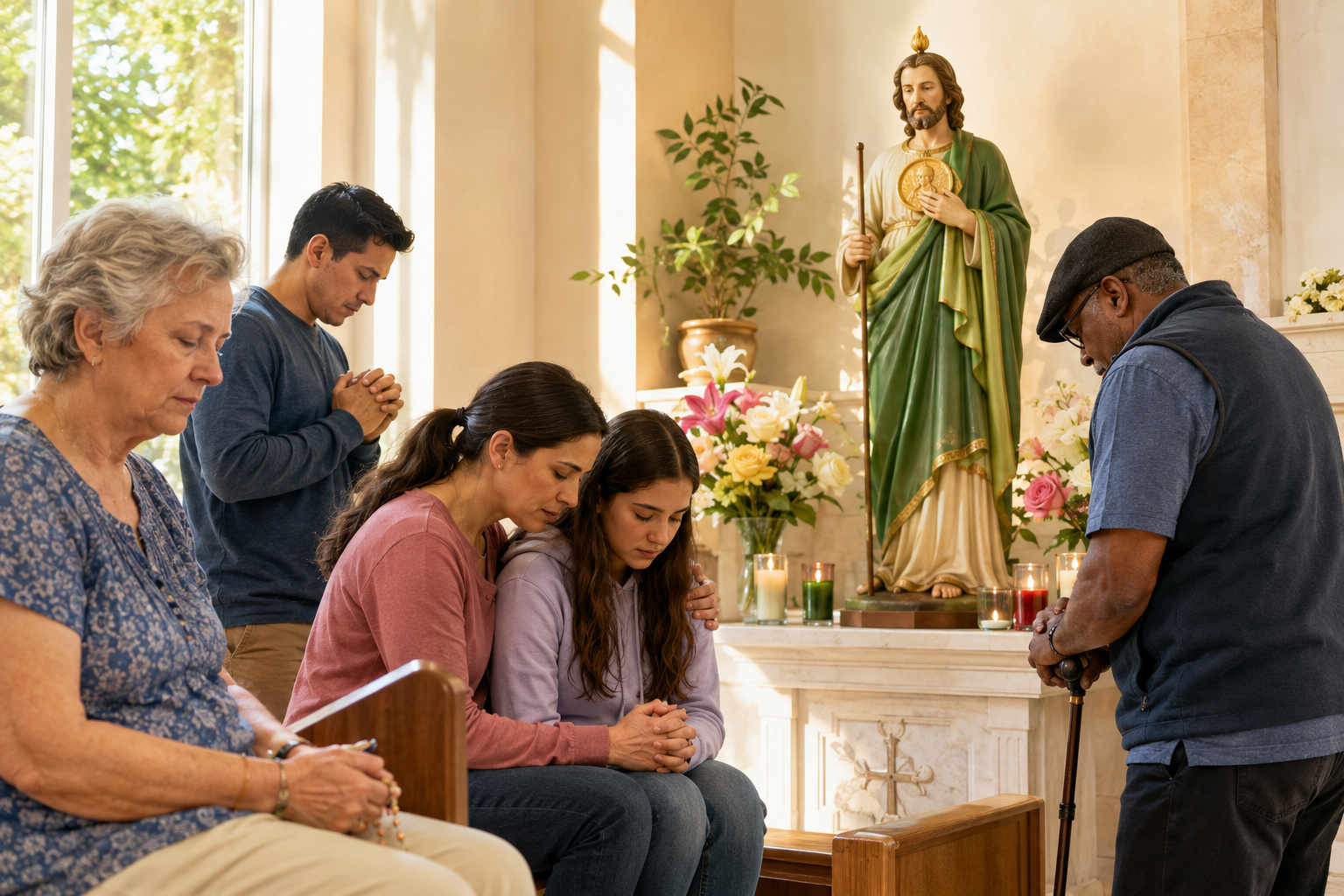 AI-generated contemporary devotional illustration of people bringing difficult needs to prayer through the intercession of St. Jude.
Most Holy Apostle St. Jude Thaddeus, faithful servant and friend of Jesus, the name of the traitor who delivered your beloved Master into the hands of the enemies has caused you to be forgotten by many, but the Church honors and invokes you universally as the patron of hopeless cases and of things despaired of.
Pray for me who am so needy; make use, I implore you of that particular privilege accorded to you to bring visible and speedy help where help is almost despaired.
Come to my assistance in this great need that I may receive the consolations and succor of heaven in all my necessities, tribulations, and sufferings particularly (here mention your petition) and that I may bless God with you and all the elect throughout eternity.
I promise you, O blessed Jude to be ever mindful of this great favor, and I will never cease to honor you as my special and powerful patron and to do all in my power to encourage devotion to you. Amen.
A DataTorch Prayer Asking St. Jude’s Intercession
(The following original prayer was prepared for DataTorch readers. Those passing through a seemingly impossible situation may pause here and ask for St. Jude’s intercession.)
St. Jude Thaddeus, faithful Apostle and friend of Jesus,
I turn to you in this time of difficulty and uncertainty.
Please pray for me and present my need before God.
[Pause and mention your intention.]
Ask the Lord to give me help according to his loving will,
courage when I am afraid,
wisdom when I cannot see the way,
perseverance when my hope grows weak,
and peace if the answer is different from what I desire.
May this trial draw me nearer to God
and make me more compassionate towards others who suffer.
Help me to trust, to continue praying
and to take the next step with faith.
St. Jude, patron of difficult and desperate causes, pray for me.
Amen.