St Josephine Bakhita: The Woman Who Found Freedom and Chose Forgiveness
A Childhood Taken Away
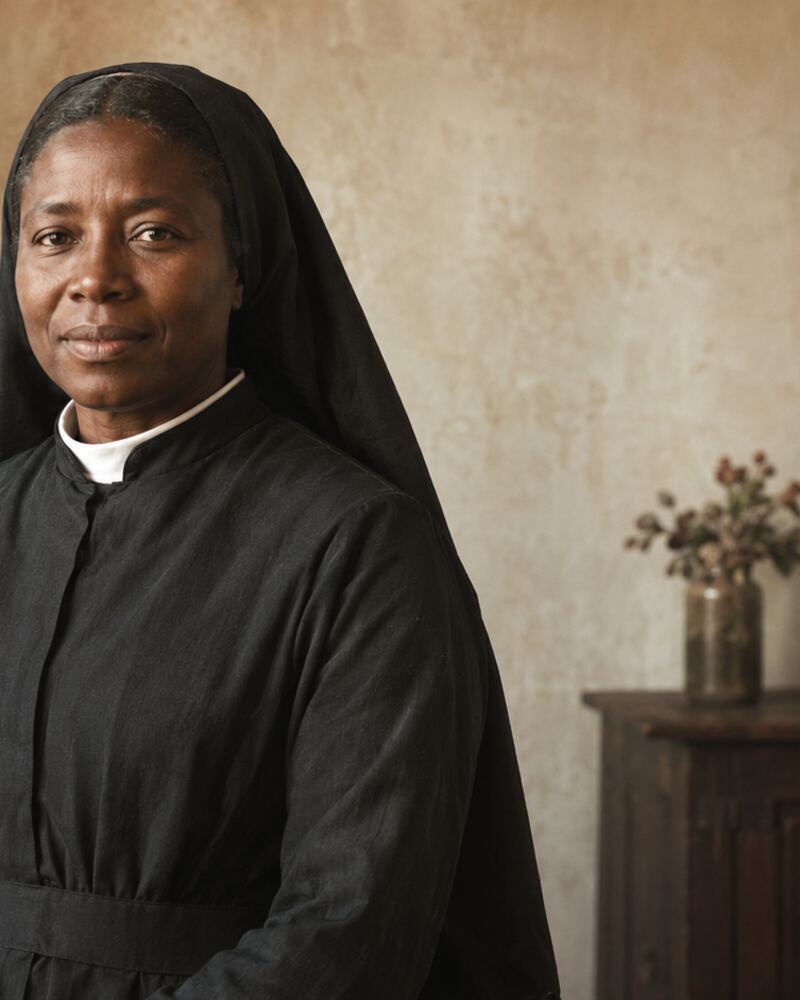 AI-generated portrait illustration of St Josephine Bakhita, based broadly on her documented historical appearance. It is not an authentic photograph.
Josephine Bakhita was born around 1869 in the village of Olgossa, in the Darfur region of Sudan. She belonged to the Daju people and lived with her family near the slopes of Jebel Marra.
Her childhood ended when she was about nine years old. While walking near her village with another girl, she was captured by slave raiders.
The child who would become known as Bakhita was dragged away from everyone she knew. She was forced to walk with other captives and was sold repeatedly. The terror of the experience was so severe that she forgot the name her parents had given her.1, 3
Her captors called her Bakhita, an Arabic name meaning “fortunate” or “lucky.” It was a cruel irony, but it became the only childhood name she carried into the rest of her life.
The Scars She Carried
Bakhita passed through the hands of several owners in El Obeid and Khartoum. Some treated her with less cruelty than others, but she remained a human being regarded as property.
Under one household, she endured a deliberate scarification procedure. Flour, salt and a blade were used to cut patterns into her skin. The wounds were rubbed so that the scars would remain. A later account recorded that she carried 144 scars on her body.3
In 1882, Bakhita was acquired for Callisto Legnani, the Italian consul in Khartoum. He did not use the lash when giving orders and treated her with greater humanity. When political conflict forced him to leave Sudan, Bakhita travelled with him to Italy. She later entered the household of Augusto and Turina Michieli and cared for their young daughter, Mimmina.1
The God Who Knew Her
In 1888, Bakhita and Mimmina were placed temporarily in the Institute of the Catechumens in Venice, which was administered by the Canossian Sisters.
There Bakhita received Christian instruction and began to understand the faith towards which she had long felt drawn. She remembered looking at the sun, moon and stars as a child and wondering who had made such beautiful things.1
The Christian message changed the way she understood herself. Human masters had treated her as property. Now she heard of a God who had created her, knew her and loved her.
Pope Benedict XVI later used her story to explain Christian hope. He summarised the certainty Bakhita had discovered:
“I am definitively loved and whatever happens to me—I am awaited by this Love.”3
Her faith did not erase the injuries of the past. It gave her a new identity that no owner could grant or remove: she was a person loved by God.
The Day She Chose for Herself
When Turina Michieli returned and prepared to take Mimmina and Bakhita back to Sudan, Bakhita refused to go.
It was a decisive moment. The woman who had been commanded, transferred and sold since childhood now stated her own will. She wanted to remain with the Canossian Sisters.
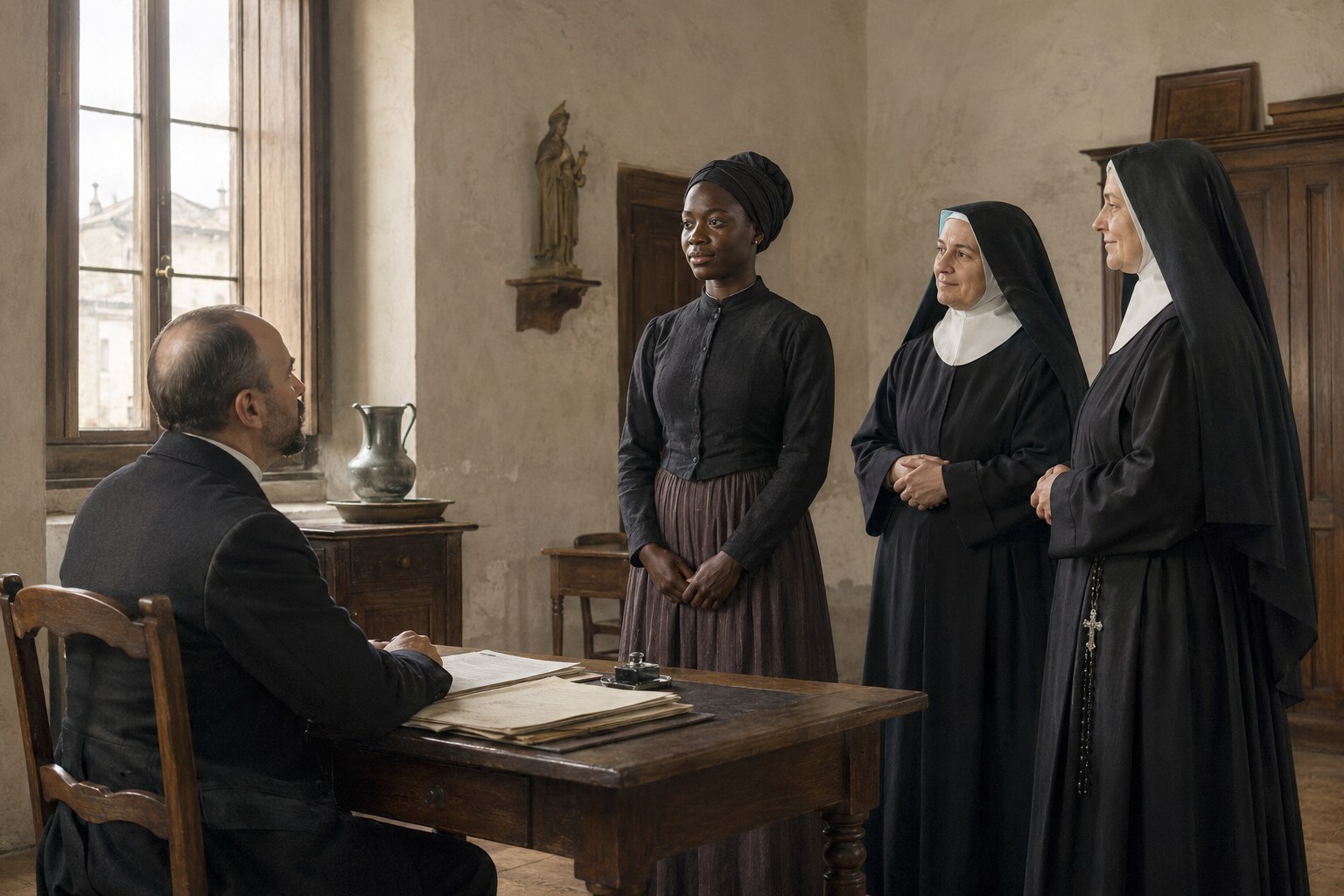 AI-generated historical reconstruction of Bakhita’s 1889 decision to remain in Venice. It is an illustration of a documented turning point, not an authentic image of the event.
The dispute reached civil and Church authorities in Venice. It was determined that Italian law did not recognise slavery and that Bakhita could not legally be compelled to leave. In 1889, she was formally free.1, 6
Her refusal was neither loud nor violent. It was the clear decision of a woman who had discovered that she possessed both dignity and a will of her own.
On 9 January 1890, she was baptised and confirmed and received her First Communion. She took the names Josephine Margaret Fortunata. She later entered the Canossian novitiate and made her religious vows on 8 December 1896.1, 2
A Life Freely Given
Josephine Bakhita spent most of her religious life in Schio, in northern Italy. She cooked, sewed, embroidered, assisted in the sacristy and welcomed visitors at the convent door.
These duties were ordinary. The spirit in which she performed them made a deep impression. Children were drawn to her calm voice and kindness. People burdened by poverty, fear or grief found that she listened without impatience.
She also travelled to Canossian communities and helped prepare young sisters for missionary work in Africa. Her body remained in Italy, but her thoughts often returned to Sudan.2, 3
The contrast with her earlier life was profound. Under slavery, her labour had been taken from her. As a religious sister, she gave her work freely. Service was no longer proof that another person owned her; it was an expression of the person she had chosen to become.
Forgiveness Without Excusing Slavery
Bakhita became known for saying that, if she met those who had kidnapped and tortured her, she would kneel and kiss their hands. She believed that, through the difficult path of her life, she had eventually come to know God.
Her words were an expression of personal forgiveness. They did not make slavery acceptable, deny the evil done to her or require other survivors to speak in the same way.
The Church itself presented her as an advocate of genuine freedom. At her canonisation, Pope John Paul II said that her story should inspire firm action to free women and girls from oppression and violence and restore their full dignity and rights.4
Bakhita refused to allow hatred to become another master. Forgiveness did not change the past. It prevented those who had harmed her from continuing to rule her inner life.
When the Chains Returned to Her Memory
In her final years, Bakhita suffered illness and increasing physical weakness. During periods of distress, memories of enslavement returned with painful force.
Near the end of her life, she was heard asking that the chains be loosened because they were heavy. The past she had transformed through faith and forgiveness had not simply disappeared. Trauma could still enter the present.1
Yet those memories did not have the final word. She soon became peaceful again. Josephine Bakhita died in Schio on 8 February 1947.
Her life shows that spiritual strength does not require a person to feel no pain. Healing can coexist with scars, difficult memories and moments of fear.
Why the Church Recognised Her as a Saint
Josephine Bakhita was not declared a saint simply because she had suffered. Many people suffer without their lives being formally examined by the Church.
Her cause considered the way she lived after gaining freedom: her trust in God, faithful prayer, humility, service, forgiveness and consistent care for others. In 1978, the Church formally recognised the heroic practice of her virtues.1
The canonisation process also examined her lasting reputation for holiness and reported favours attributed to prayers for her intercession. Pope John Paul II beatified her on 17 May 1992 and canonised her on 1 October 2000.2, 4
Her sainthood therefore rests not upon what slavery did to her, but upon what she freely chose to become: a woman of faith who answered cruelty with dignity, service and forgiveness.
In Khartoum in 1993, John Paul II described her as a model of reconciliation and love because she overcame hatred towards those who had harmed her.5
DataTorch Closing Thought
Josephine Bakhita could not choose what was done to her as a child. Later, when freedom finally became possible, she chose with courage: she chose to remain, to learn, to believe, to serve and to forgive.
Her forgiveness did not call slavery good. Her faith did not make her wounds imaginary. Her gentleness was not weakness. Each was an act of freedom by a woman who would no longer permit cruelty to define the limits of her life.
Her story asks more of us than admiration. It asks whether we recognise the full humanity of people whose freedom is threatened, whether we listen to survivors and whether we act when human beings are treated as possessions.
Freedom reaches its fullest meaning when we use our own freedom to protect the dignity and freedom of others.