St Francis of Assisi: The Freedom He Found in Letting Go
The Day Francis Gave Everything Back
Assisi had known Francis as the son of a prosperous cloth merchant. He had grown up surrounded by fine fabrics, money and the expectations of a comfortable future. But one day, in the presence of the Bishop of Assisi, his father Pietro di Bernardone stood against him in a dispute that had reached the point of no return.
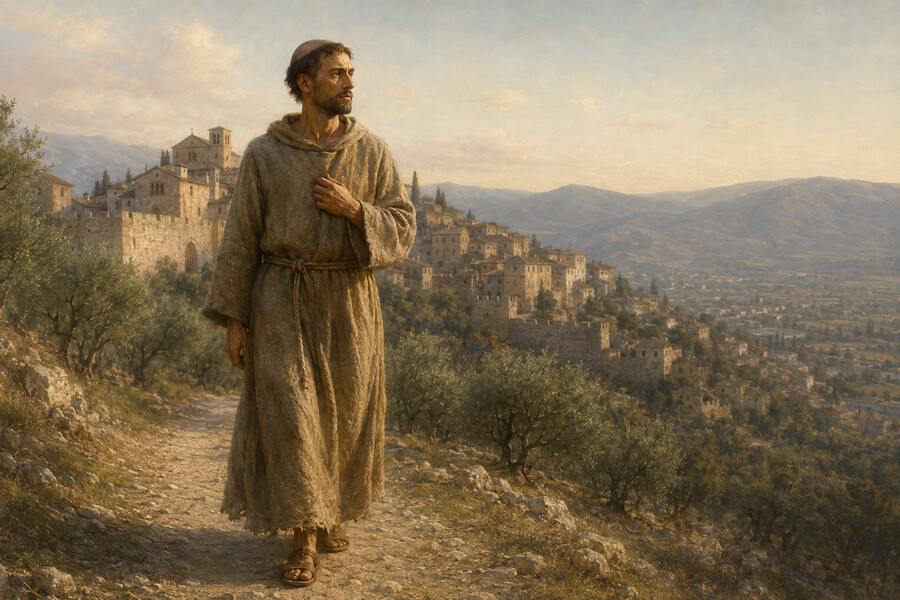 AI-generated historical reconstruction of St Francis Assisi
Francis did something no one in the room could mistake.
He gave up his claim to his father's property. Then he removed the clothes he was wearing and returned them too.
For a moment, the young man who had once dreamed of honour and a fine place in the world stood with nothing. The bishop rose and covered him with his cloak.23
Francis walked away from the life his father had prepared for him.
But this was not where his story of letting go had begun. To find its beginning, we have to go back to the young Francis who had once wanted something very different.
The Dream of Glory That Began to Fade
Francis was born in Assisi at the end of 1181 or beginning of 1182. His father was a successful cloth merchant, and Francis enjoyed the advantages of a wealthy home. He was lively, sociable and attracted by the chivalric ideals of his age. The world of knights promised adventure, honour and glory.
At about twenty, Francis went to war in the struggle between Assisi and Perugia. In 1202 he was captured and spent a long period as a prisoner. Then came illness and, eventually, freedom.23
He returned to Assisi, but the old Francis had not completely disappeared. Military glory still attracted him. He set out again, hoping for the life of a knight.
He did not get far.
Early Franciscan accounts describe experiences during this period that Francis understood as God's direction. The journey towards military glory ended, and he returned to Assisi. What followed was not one sudden change but a slow conversion.
The merchant's son began spending more time in prayer and solitude. The noisy ambitions of his youth were becoming quieter. And then his path brought him face to face with people from whom he had always wanted to turn away.
The People He Could Hardly Bear to See
In those days, people suffering from leprosy lived on the edges of society. Their illness frightened others; their presence could bring fear and disgust.
Francis knew that feeling well.
Many years later, near the end of his life, he wrote honestly in his Testament that it had once seemed “too bitter for me to see lepers.”1
Then something changed.
Francis went among them. He cared for them and showed them mercy. Later biographies tell the famous story that he dismounted from his horse and gave a leper the kiss of peace. Francis himself did not describe that detail. He simply remembered that he went among the lepers and served them.
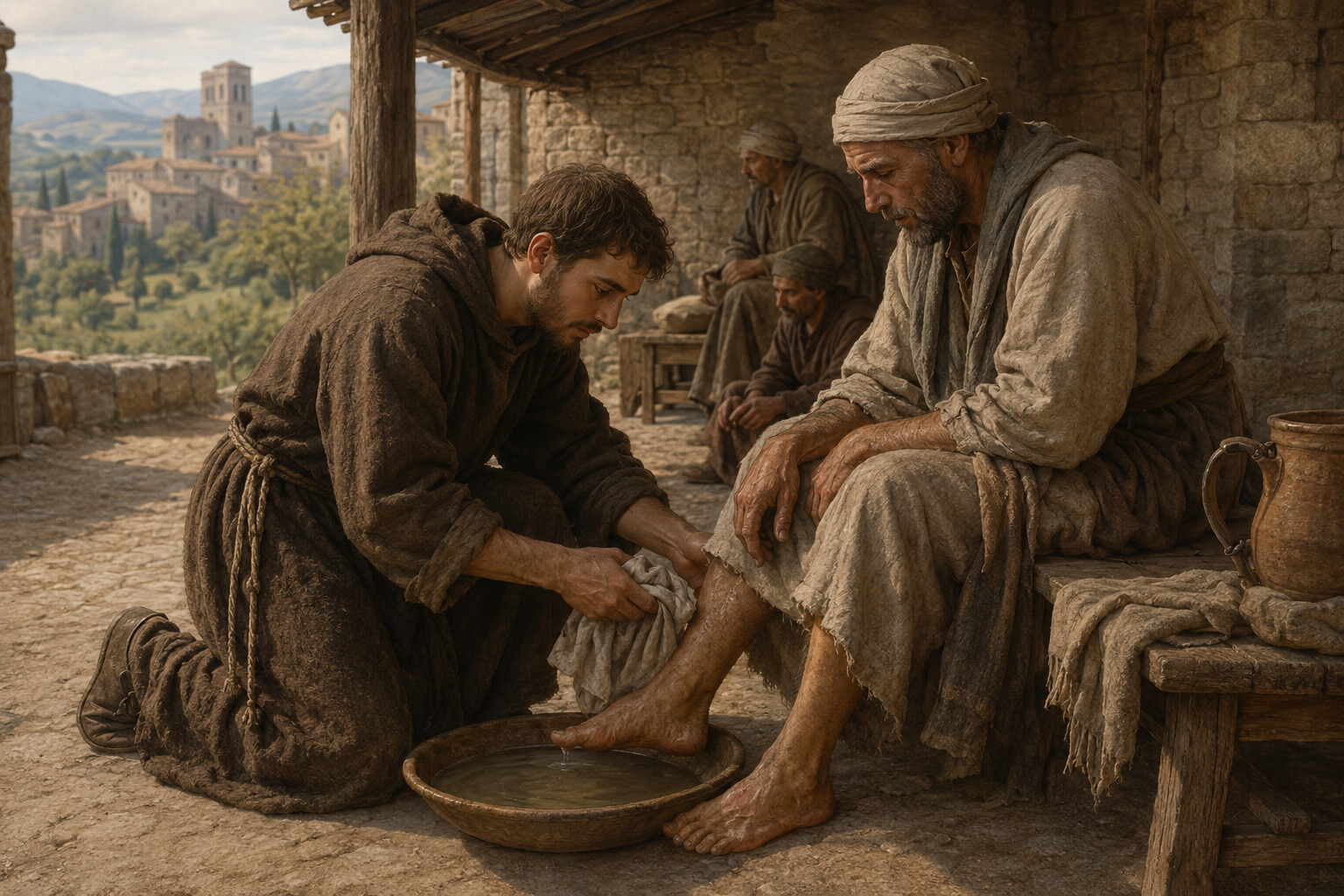 AI-generated historical reconstruction of Francis serving people with leprosy near Assisi. It illustrates the mercy Francis himself recalled in his Testament.
What happened afterwards remained so important to him that he included it in the short account he left to his brothers at the end of his life:
“What had seemed bitter to me was turned into sweetness of soul and body.” — St Francis, Testament1
The roads around Assisi had not changed. Leprosy had not disappeared. But Francis was no longer walking those roads with the same heart.
Soon another encounter would give his changing life a direction.
“Repair My Church”
Outside Assisi stood the small church of San Damiano. It was old and badly damaged. Francis went inside to pray before a crucifix.
According to the early Franciscan accounts, as he prayed he experienced Christ speaking to him from the crucifix:
“Go, Francis, and repair my Church in ruins.”23
Francis began with the meaning he could see in front of him. The little church really was falling into ruin, so he set about repairing it. He gathered materials and worked with his hands. San Damiano was not the only neglected church he helped rebuild.
But his efforts also brought him into conflict with his father. Francis had taken valuable cloth, sold it at Foligno and tried to give the money for the work at San Damiano. The priest, afraid of trouble with Francis's family, would not accept it. Pietro wanted his property back and wanted his son back from a course of life he could not understand.
The conflict eventually reached the Bishop of Assisi.
And so the story returned to the scene with which we began.
Francis gave up his inheritance and handed back his clothes. The bishop covered him. Then Francis went on his way.
He had once expected to wear the clothes of a prosperous merchant's son or perhaps the armour of a knight. Now he chose the rough clothing of a poor man and continued repairing churches.
The words he had heard at San Damiano would reach far beyond stone walls.
What Was Left When Possessions Were Gone?
In 1208, while Francis was listening to the Gospel account of Jesus sending his disciples out to preach, the next step became clear to him. He wanted to live the Gospel simply and directly, in poverty, prayer and service.
Soon he was no longer alone.
Men began joining him. Francis called them brothers. They worked, prayed, preached and depended on little. In his Testament, Francis later remembered that those who joined the fraternity gave what they had to the poor. He wrote of those early days with striking simplicity: “We desired nothing more.”1
By 1209 the small brotherhood had grown enough for Francis to travel to Rome. He went not to break away from the Catholic Church, but to seek the approval of Pope Innocent III for their way of life. The Pope accepted their form of Gospel life, and the movement continued to grow.2
The young man who had once surrendered his inheritance now carried no family fortune with him. Yet companions were gathering around him, Clare of Assisi would begin another Franciscan community, and the little movement would spread beyond Italy.
Years passed. The world beyond Assisi was far from peaceful, and eventually Francis walked into the middle of one of its wars.
Crossing the Battle Lines — Francis and the Sultan
In 1219 Christian and Muslim armies were fighting in Egypt during the Fifth Crusade. The siege of Damietta had brought bloodshed, hunger and disease.
Francis arrived in the crusader camp with another friar. Beyond the military lines was the camp of the Muslim Sultan of Egypt, al-Malik al-Kamil.
Francis decided to cross over.
He did not go carrying a weapon. He went as a Christian friar who wanted to preach his faith.
Crossing between two armies at war was dangerous, but Francis reached the Sultan's camp and was brought before al-Kamil. Sources from the period confirm that the meeting took place, although they do not preserve a reliable transcript of everything the two men said to each other.4
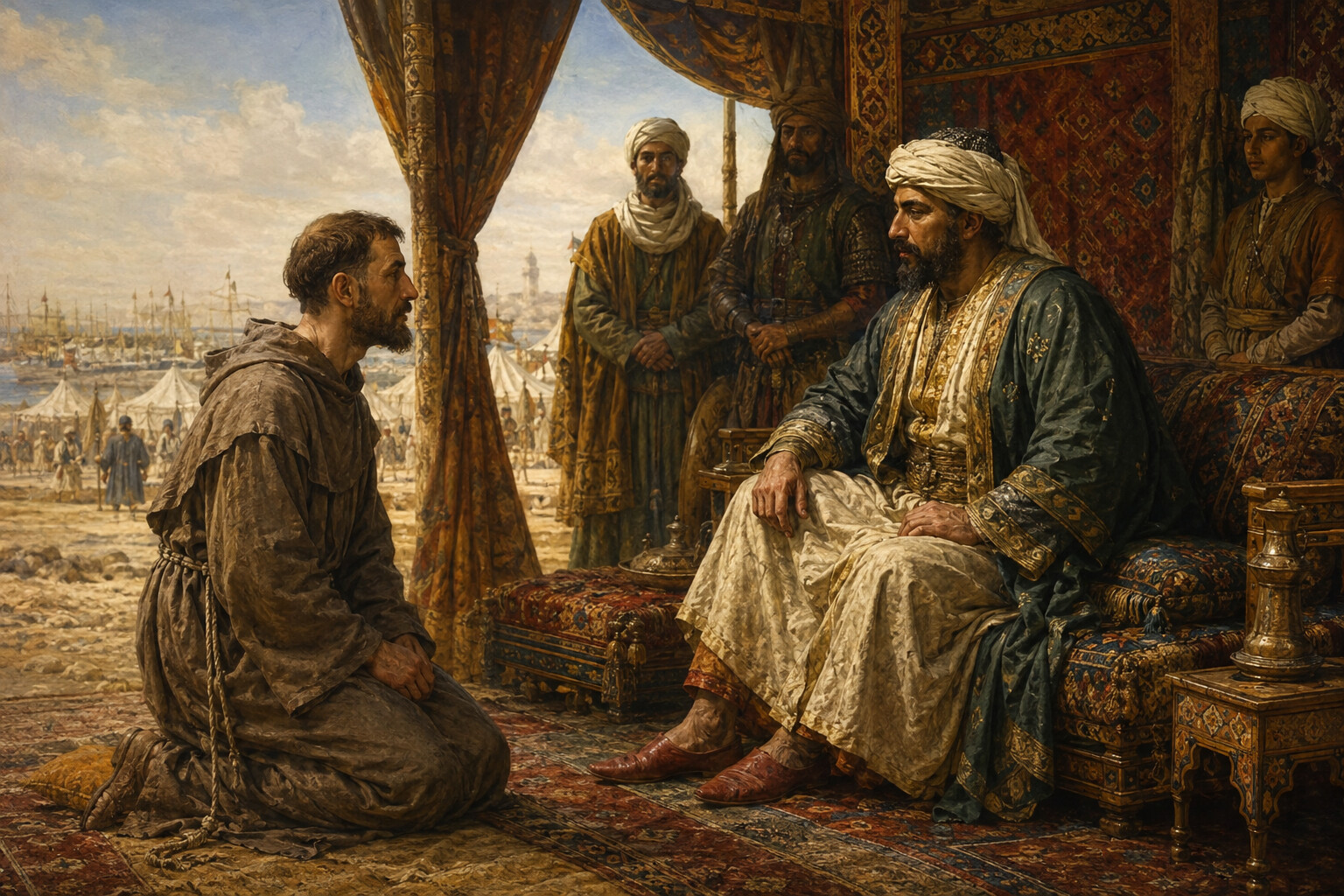 AI-generated historical reconstruction of the 1219 meeting between Francis and Sultan al-Malik al-Kamil. s.
The Sultan received Francis. Francis spoke. And after the encounter, he was allowed to leave safely.
The war did not end. The two men did not erase the differences between their faiths. Francis remained a Christian missionary; al-Kamil remained a Muslim ruler. Yet amid a crusade, they had met face to face without killing one another.
Francis eventually returned to Italy. By then the brotherhood he had begun was becoming large and difficult for one man to guide. He handed much of its administration to others and continued along the path that had begun years earlier in Assisi.
His body, however, was growing weaker.
Seeing Beauty While Losing His Sight
Illness accompanied Francis through his final years. His eyesight became seriously impaired, and there were periods of great physical suffering.
In 1224 he withdrew to La Verna, a mountain retreat in Tuscany. Early Franciscan sources describe an extraordinary experience there. Francis saw a vision of a six-winged figure like a seraph bearing the image of the crucified Christ. Afterwards, wounds resembling the wounds of the Crucifixion were seen on his hands, feet and side.23
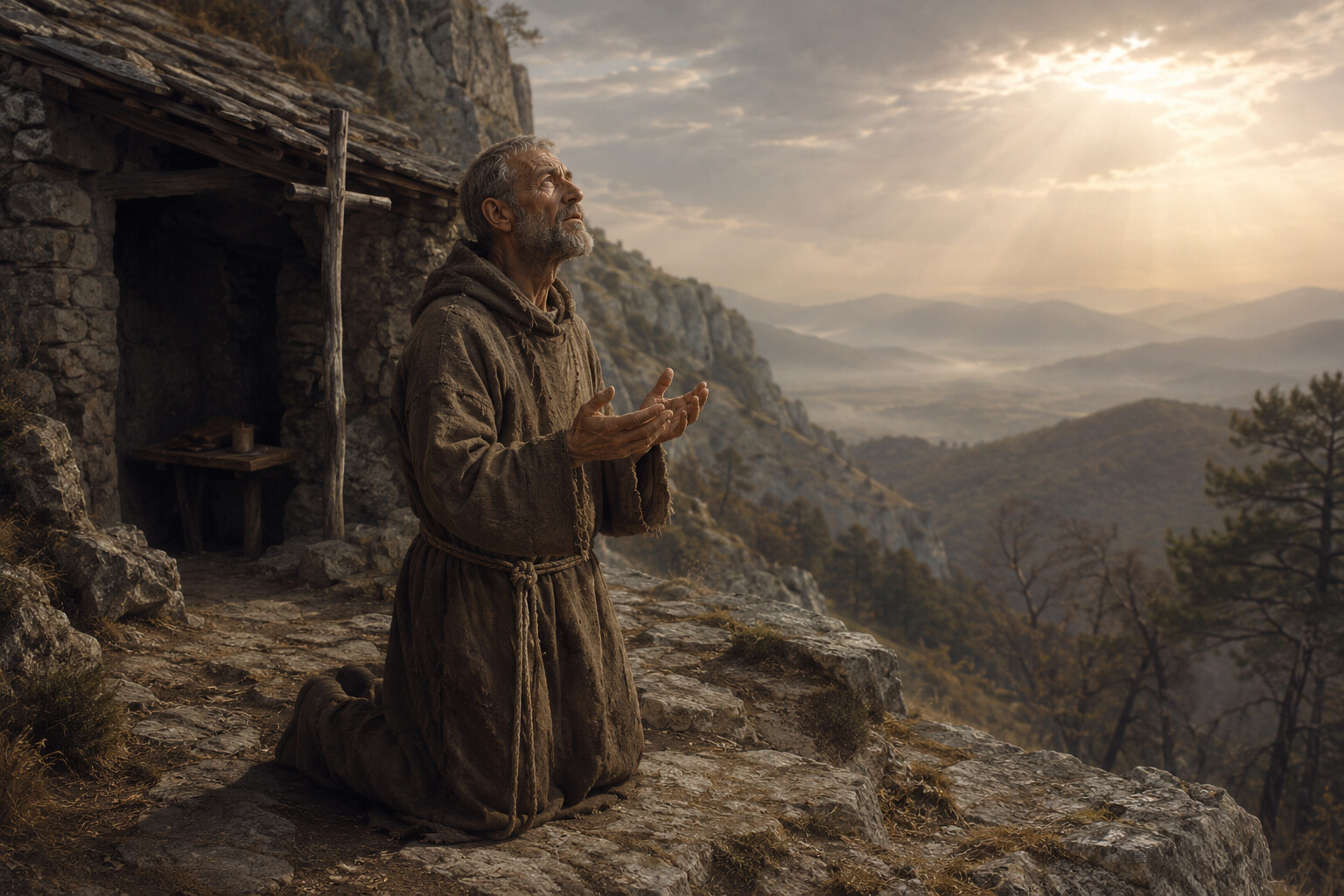 AI-generated historical reconstruction of Francis praying at La Verna in 1224. Early Franciscan sources connect this retreat with his vision and the stigmata.
Thomas of Celano, Francis's earliest biographer, recorded the stigmata only a few years after Francis's death. For Franciscan and Catholic tradition, they became one of the most remarkable signs associated with his closeness to the suffering Christ.
But the suffering did not stop there.
By 1225 Francis was ill and troubled by his failing sight. He was staying near San Damiano, the place where years earlier he had prayed before the crucifix and begun repairing a ruined church.
There, in weakness and darkness, came a song.
Francis composed the Canticle of the Creatures, praising God through the things of the world around him—sun, moon and stars, wind, water, fire and earth. Its opening turns outward rather than inward:
“Praised be You, my Lord, with all Your creatures.” — St Francis, Canticle of the Creatures5
His eyes could no longer easily enjoy the brightness of the world, yet his song was full of creation. Later verses also spoke of forgiveness, peace, suffering and finally “Sister Bodily Death.”
Francis was approaching her.
The Wonders Remembered Around Him
By this time, stories of remarkable events had gathered around Francis. Some were recorded very early by people who knew the first generation of friars.
Thomas of Celano tells of a time when Francis was seriously ill at the hermitage of St Urban. Water was brought to him. According to Celano, it became wine, and after Francis drank it his health improved with extraordinary speed. Celano also recorded healings that people associated with Francis and with objects he had blessed or touched.3
The friars who preserved such accounts saw them as signs of God's work through Francis. Other stories would be added and retold in later generations, forming a rich Franciscan tradition around the little poor man of Assisi.
Francis, meanwhile, continued to speak most often about the things he had tried to live from day to day: mercy, prayer, work, poverty, peace, the Gospel and faithfulness to Christ.
In 1226, knowing that death was near, he left his Testament to the brothers. In it he looked back not first to fame or wonders, but to the beginning—to the lepers, to mercy, to the brothers God had given him, and to the Gospel way of life they had tried to follow.1
His last journey brought him back to the Portiuncula, the small church so closely connected with the first Franciscan brothers.
On the evening of 3 October 1226, Francis died there.
He was about forty-four years old.
Two years later, Pope Gregory IX declared him a saint.2
The merchant's son who had once dreamed of worldly glory became known across the world for something very different: a life in which he kept learning to let go.
What Francis Still Asks of Us
Francis's world was medieval Assisi, but the things he struggled to release are still familiar: the desire to be important, the security of possessions, fear of people who make us uncomfortable, the division between enemies, and the fear that suffering will leave us with nothing.
His life did not change in a single day.
War disappointed him. Illness weakened him. Prayer redirected him. He approached the people he had once avoided. He gave back the wealth that had defined his place in society. He began again with almost nothing. He crossed a battlefield to meet a Muslim ruler. When his sight was failing, he still found words to praise the beauty of creation.
We do not have to give away all our possessions or copy the austerity of a thirteenth-century friar to hear the question inside his story.
What am I holding so tightly that it has begun to hold me?
For one person it may be money. For another, status, resentment, prejudice, fear, comfort, or the constant need for more.
Francis spent much of his life letting such things go. What remained was not emptiness. For him, the space filled with God, mercy, fraternity, gratitude and peace.
DataTorch Closing Thought
Sometimes freedom begins when we loosen our grip. What we own, achieve or protect should help us live—not become the master of our life. Let go of what has begun to own your heart, and make room for mercy, gratitude and peace.
Sources
- Francis of Assisi, The Testament (1226), Order of Friars Minor. Primary Franciscan text used for Francis's recollections of the lepers, the beginnings of the fraternity and the Gospel way of life.
- Benedict XVI, General Audience, 27 January 2010, “Saint Francis of Assisi,” Holy See. Used for the principal chronology of Francis's youth, conversion, renunciation, papal approval, stigmata, death and canonisation.
- Thomas of Celano, First and Second Lives of Saint Francis, excerpts in Fordham University's Internet Medieval Sourcebook. Early Franciscan biographical material used for the renunciation, visions, stigmata and reported miraculous events.
- Order of Friars Minor, St Francis and the Sultan, 1219–2019. Historical study used for the 1219 meeting between Francis and Sultan al-Malik al-Kamil and the limits of what is known about their conversation.
- Order of Friars Minor, The Canticle of the Creatures, 1225–2025. Used for the historical setting and short quotation from Francis's Canticle of the Creatures.
Images: The illustrations on this page were generated for DataTorch as historical reconstructions. They are not authentic portraits or contemporaneous depictions of Francis or the events shown. The La Verna illustration deliberately does not attempt to depict the supernatural element of Francis's reported vision.