How St. Augustine found Peace in the middle of His chaos: The Divine Prompt
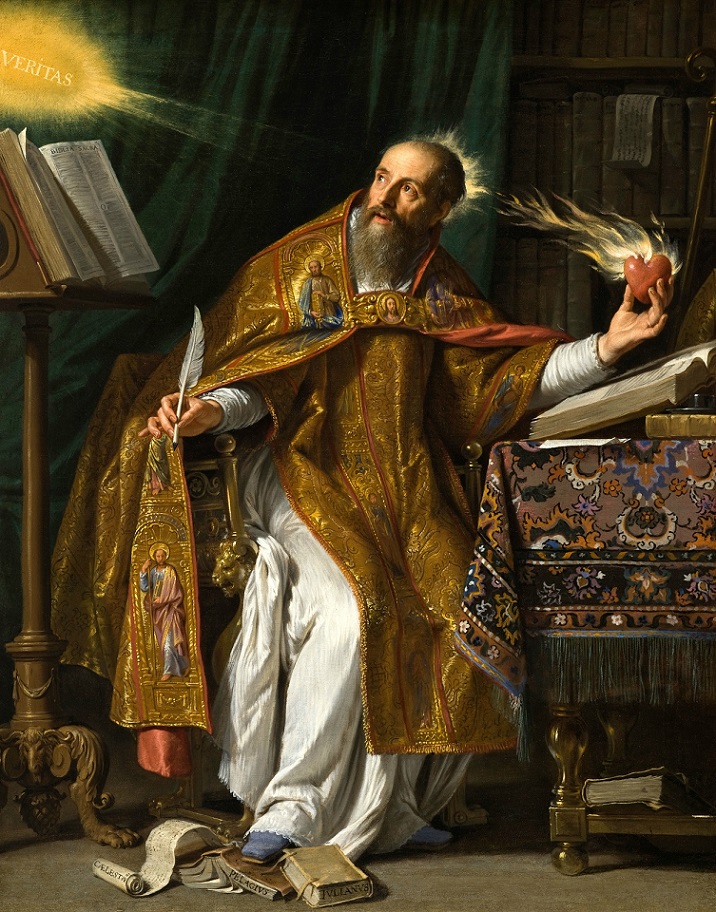 Saint Augustine
The Restless Heart
Born in North Africa in 354 AD, Augustine was a young man of immense talent. He left his small hometown to study in Carthage, the big city, where he quickly made a name for himself as a master of rhetoric (the art of public speaking and persuasion). He climbed the social and career ladders all the way to the imperial court in Milan, Italy.
To the outside world, Augustine was a massive success. He had prestige, wealth, a tight-knit circle of intellectual friends, and a love life full of passion. Yet, internally, he was miserable. In his famous autobiography, Confessions, he wrote a line that still echoes down the centuries:
"You have made us for yourself, O Lord, and our heart is restless until it rests in you."
Augustine spent years trying to quiet that inner restlessness. He tried hedonism and partying. He tried diving headfirst into trendy philosophical cults. He tried burying himself in his work. Nothing worked. Every time he achieved a new goal, the emptiness followed him. He knew he wanted a deeper, more meaningful life, but he felt trapped by his own habits and desires.
The Divine Prompt
By the summer of 386 AD, Augustine was 31 years old and at a breaking point. The mental and emotional exhaustion of living a double life—seeking truth while remaining chained to his old habits—boiled over.
One afternoon, while staying at a house in Milan with his close friend Alypius, Augustine experienced an intense emotional collapse. Unable to contain his distress, he rushed out into the garden, weeping bitterly. He threw himself down under a fig tree, crying out to the sky, asking why his inner conflict had to be so painful, and why it couldn't end right then and there.
As he lay in the grass, sobbing, he suddenly heard a sound coming from a neighboring house. It was the sweet, rhythmic voice of a child—he couldn't tell if it was a boy or a girl—singing a chant over and over again:
"Tolle lege! Tolle lege!" (Take up and read! Take up and read!)
Augustine paused. He tried to think of any childhood game where kids sang those words, but none came to mind. Damming his tears, he interpreted the child's song as a direct, divine prompt.
He stood up, walked back to where his friend Alypius was sitting, and picked up a manuscript of the New Testament letters he had left there. He opened it at random and let his eyes fall on the first passage they landed on. It was a passage from Bible- Romans 13, advising the reader to leave behind wild parties, jealousy, and shadow-living, and instead to "clothe themselves" in light and truth.
Owe no one anything, except to love one another; for the one who loves another has fulfilled the law. The commandments, “You shall not commit adultery; You shall not murder; You shall not steal; You shall not covet”; and any other commandment, are summed up in this word, “Love your neighbor as yourself.” Love does no wrong to a neighbor; therefore, love is the fulfilling of the law.
An Urgent Appeal: Besides this, you know what time it is, how it is now the moment for you to wake from sleep. For salvation is nearer to us now than when we became believers; the night is far gone, the day is near. Let us then lay aside the works of darkness and put on the armor of light; let us live honorably as in the day, not in reveling and drunkenness, not in debauchery and licentiousness, not in quarreling and jealousy. Instead, put on the Lord Jesus Christ, and make no provision for the flesh, to gratify its desires.
The Dawn of Peace
In that exact moment, the storm inside Augustine cleared. He didn't feel judged; he felt seen. In Confessions, he describes that visual transformation:
"No further would I read; nor needed I: for instantly at the end of this sentence, by a light as it were of serenity infused into my heart, all the darkness of doubt vanished away."
He marked the page with his finger, closed the book, and calmly told Alypius what had happened. The lifelong war between who Augustine was and who he wanted to be had ended under a fig tree, triggered by a child's song.
Augustine went on to become one of the most influential thinkers, writers, and philosophers in human history. His writings shaped Western thought for over a millennium.
What Augustine Teaches Us Today
Augustine’s garden moment teaches us three timeless truths:
- Ambition alone cannot fill an internal void. You can conquer your career, your social circle, and your finances, but if your soul is neglected, the restlessness will stay.
- Growth requires us to face our internal contradictions. It is entirely normal to want to change while simultaneously clinging to the very things holding you back. Acknowledging that friction is the first step to overcoming it.
- Peace often arrives when we surrender our control. Augustine spent decades trying to intellectually reason his way into peace. It was only when he broke down, wept, and simply listened to a simple child’s chant that the door finally opened.
Whenever you feel overwhelmed by your own flaws or lost in the noise of a restless life, remember the man in the Milan garden. Your messy, complicated present is not the end of your story—it might just be the chapter right before the turning point.