Srinivasa Ramanujan: The Self-Taught Genius Who Saw the Divine in Numbers
The Letter from an Unknown Clerk
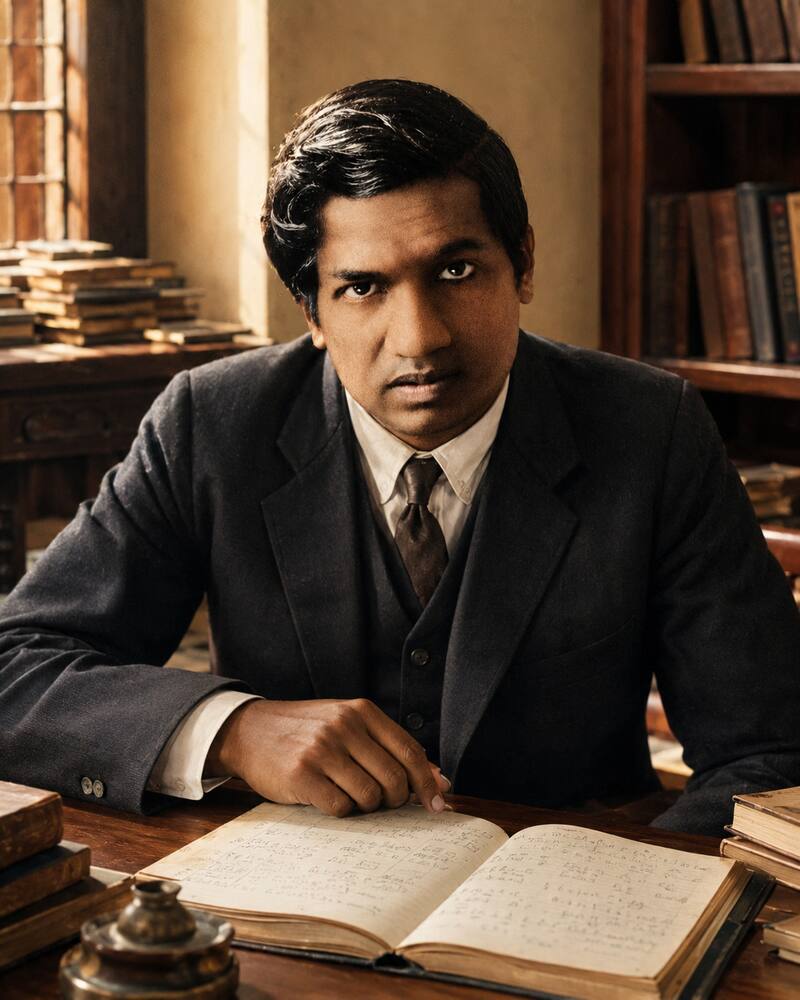 AI-generated historical reconstruction of Srinivasa Ramanujan, using his 1913 passport portrait as a facial reference. It is an illustration, not an authentic photograph of this setting.
On 16 January 1913, the distinguished Cambridge mathematician G. H. Hardy received a letter from India.
Its writer, Srinivasa Ramanujan, introduced himself as a clerk in the Accounts Department of the Madras Port Trust. He had no university degree and earned a modest salary. Enclosed with the letter were pages of unfamiliar mathematical formulas.2, 3
Ramanujan wrote:
“I have had no University education but I have undergone the ordinary school course… I am striking out a new path for myself.”2
Hardy initially wondered whether the letter might be a hoax. That evening, he examined the formulas with his colleague J. E. Littlewood. Some were already known, a few were incorrect, but others possessed an originality they could not dismiss.
Hardy later remembered that the results must be true because no one would have possessed the imagination to invent them falsely.1, 3
The unknown clerk had attracted the attention of one of Britain’s leading mathematicians. Yet the pages on Hardy’s table had emerged from years of failure, poverty, prayer and almost solitary work.
The Book That Became His University
Srinivasa Ramanujan was born on 22 December 1887 in Erode, in present-day Tamil Nadu, and grew up in Kumbakonam. His father, K. Srinivasa Iyengar, worked as a clerk in a cloth merchant’s shop. His mother, Komalatammal, was deeply religious and sang devotional songs at a local temple.3
Ramanujan showed unusual mathematical ability as a schoolboy. While still a teenager, he obtained G. S. Carr’s A Synopsis of Elementary Results in Pure and Applied Mathematics.
The book contained thousands of mathematical results, usually presented with little explanation. Ramanujan began working through them, reconstructing proofs and discovering new relationships of his own. Carr’s compressed style influenced him deeply: Ramanujan often recorded conclusions while leaving out the intermediate reasoning.1, 3
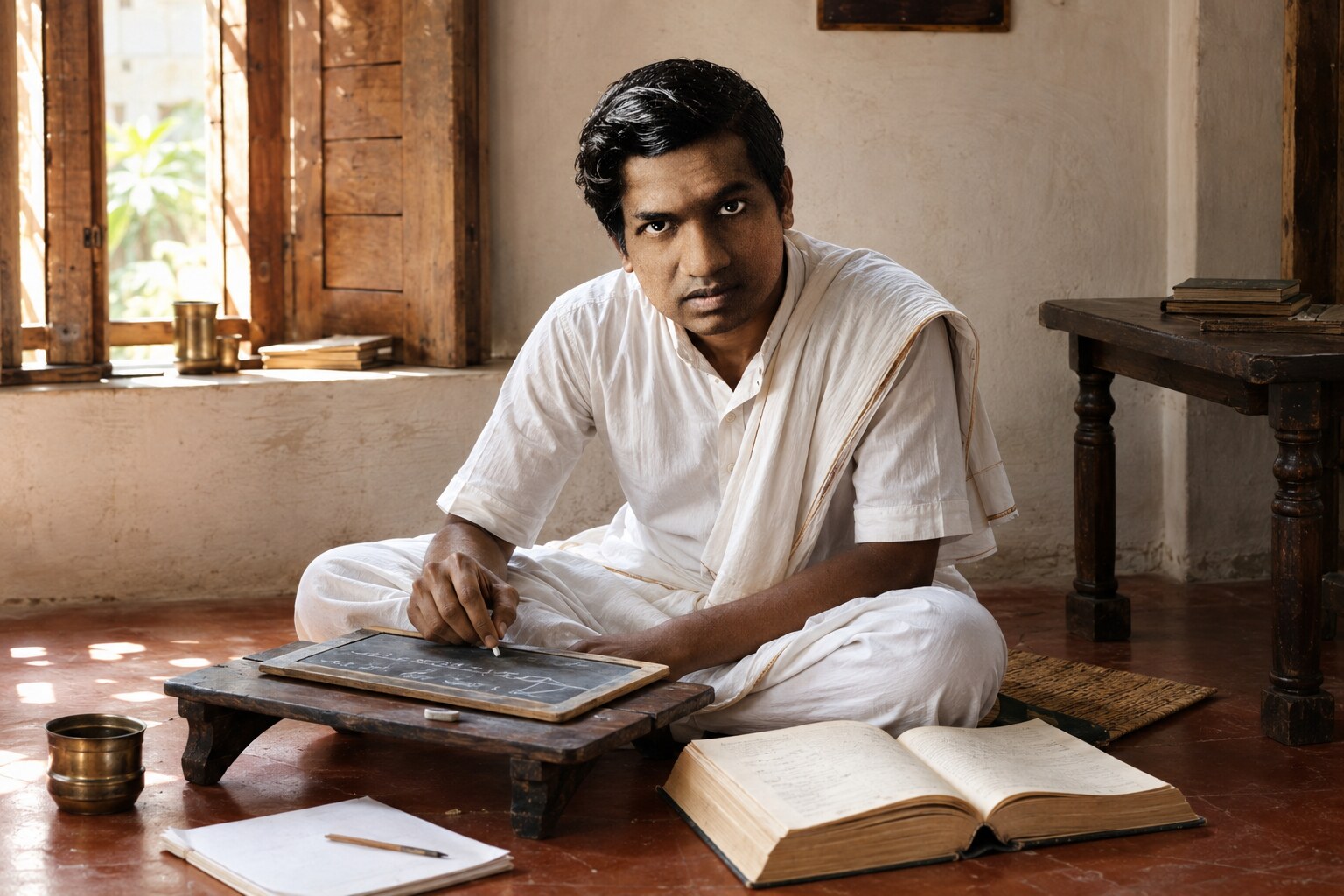 AI-generated historical reconstruction inspired by Ramanujan’s teenage study of mathematics in Kumbakonam. It is an illustration, not an authentic image of a particular moment.
In 1904, he received a scholarship to Government Arts College in Kumbakonam. But his attention had become almost entirely absorbed by mathematics. He neglected English, physiology and other required subjects, failed his examinations and lost the scholarship.
He later entered Pachaiyappa’s College in Madras. Once again, he excelled in mathematics but failed the other subjects necessary for a degree.
The same concentration that opened an extraordinary mathematical world had closed the ordinary route to academic employment. Ramanujan left college without a degree, continued his investigations independently and filled notebooks with formulas that few people around him could understand.3
His family arranged his marriage to Janakiammal in 1909. The responsibility of supporting a household made his search for employment increasingly urgent.
The Frayed Notebook
Ramanujan travelled around Madras seeking someone who could understand his work. He approached teachers, civil servants and mathematically interested officials, carrying his notebooks with him.
In 1911, Ramanujan published his first substantial paper, on Bernoulli numbers, in the Journal of the Indian Mathematical Society. Yet recognition did not immediately provide a livelihood.
On 1 March 1912, he began working as a clerk at the Madras Port Trust. His official duties involved accounts, but his mathematical investigations continued during his available hours. S. Narayana Iyer, the Chief Accountant, encouraged him, while the chairman, Sir Francis Spring, helped bring his work to wider attention.3, 4
Ramanujan sent his results to mathematicians in Britain. Some did not reply; others were unconvinced. Then his letter reached Hardy.
When Hardy asked for proofs, Ramanujan replied with relief:
“I have found a friend in you who views my labours sympathetically.”2
He also stated his difficulty plainly:
“To preserve my brains I want food, and this is now my first consideration.”3
With Hardy’s support and the efforts of Indian scholars and officials, the University of Madras awarded Ramanujan a research scholarship in 1913. For the first time, he could devote himself to mathematics without depending upon clerical employment.1, 3
The Goddess in the Mathematics
Ramanujan’s mathematical life cannot be understood fully without his Hindu faith.
His family was devoted to Namagiri Thayar, the form of Goddess Lakshmi worshipped at Namakkal. Ramanujan observed religious practices, remained a strict vegetarian and understood mathematical insight within a spiritual view of existence.
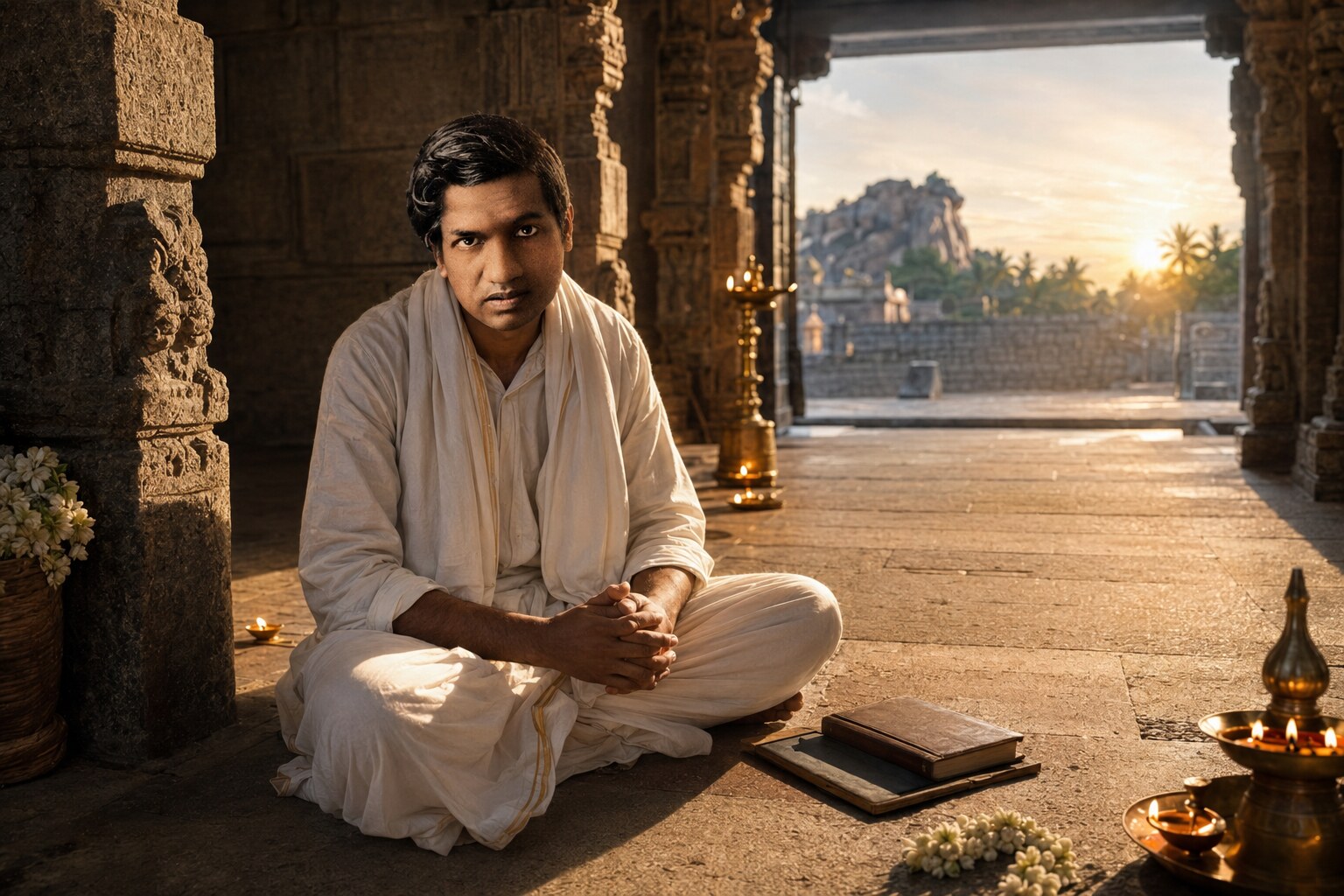 AI-generated symbolic reconstruction of Ramanujan’s devotion to Namagiri Thayar. It does not depict a documented vision or a particular recorded prayer.
K. S. Viswanatha Sastri, a friend from Ramanujan’s youth, later remembered that for Ramanujan the pursuit of mathematics was also a pursuit of God.8
Biographer S. R. Ranganathan recorded a sentence long attributed to him:
“An equation for me has no meaning unless it expresses a thought of God.”7
Ramanujan believed that Namagiri sometimes revealed mathematical ideas to him. A reminiscence published after his death describes him recounting an unusual dream: he saw a red screen, as though formed by flowing blood, upon which a hand began writing results involving elliptic integrals. He reportedly said that he wrote the results down upon waking.8
Such an experience belongs to Ramanujan’s personal testimony as preserved by others; it cannot be independently verified. Yet its importance in his life should not be ignored. He did not regard mathematics as a collection of lifeless symbols. He experienced it as a reality filled with meaning and, at times, divine disclosure.
This did not mean that every formula entered his notebooks without effort. His surviving work reveals intense calculation, experimentation, memory and perseverance. Some of his claims were mistaken or incomplete; many others proved extraordinarily deep.
Faith shaped the meaning Ramanujan gave to his insights. Mathematical examination determined whether those insights could be established.
The Dream That Opened the Way
Hardy wanted Ramanujan to come to Cambridge. Ramanujan initially hesitated.
Travelling across the sea conflicted with religious and social restrictions observed by many members of his community. His mother also opposed the journey, and Ramanujan did not wish to go against her.
E. H. Neville, a Cambridge mathematician visiting Madras, spent considerable time encouraging him. Neville later recorded the event that changed the family’s decision.
According to his account, Ramanujan’s mother had a vivid dream in which she saw her son surrounded by Europeans. The Goddess Namagiri then commanded her not to stand between Ramanujan and the fulfilment of his life’s purpose.5
The dream was a family spiritual experience, known through Neville’s later recollection. Whatever interpretation others may give it, the practical consequence was clear: his mother withdrew her opposition.
Supported by the University of Madras, Ramanujan sailed for England on 17 March 1914. Janaki and his mother remained in India.1, 3
The mathematical clerk was travelling towards Cambridge, carrying the culture and faith of his home—and notebooks that would astonish the academic world.
Two Different Minds at Cambridge
Ramanujan arrived in England in April 1914, only months before the First World War began.
Cambridge brought intellectual companionship but also severe personal difficulties. The climate was unfamiliar, wartime conditions made suitable vegetarian food difficult to obtain, and separation from his family increased his isolation.1
Hardy and Ramanujan were remarkably different. Hardy was an atheist trained in the rigorous traditions of European mathematics. Ramanujan was a devout Hindu whose insight often arrived intuitively and whose notebooks commonly omitted proofs.
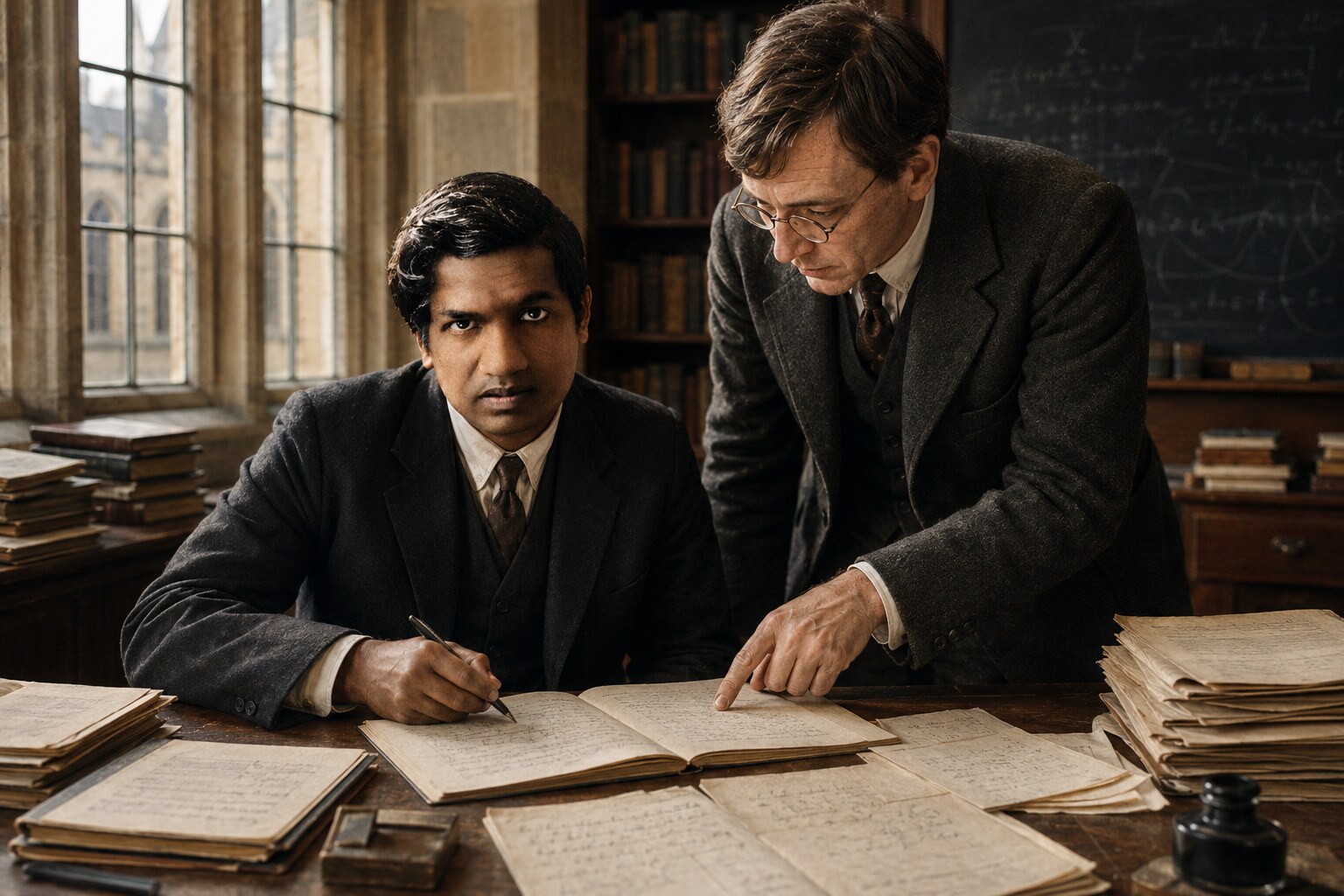 AI-generated historical reconstruction inspired by the mathematical partnership of Srinivasa Ramanujan and G. H. Hardy at Cambridge. It is not an authentic photograph of a particular meeting.
Despite their different approaches, their partnership joined intuition with proof. Ramanujan worked on infinite series, continued fractions, number theory, modular equations and partitions—the different ways in which a whole number can be written as a sum of positive integers.1, 3
In 1916, Cambridge awarded him a Bachelor of Arts degree by research for his work on highly composite numbers.
By 1917, however, his health had deteriorated seriously. He suffered recurring fever, pain, weight loss and exhaustion, spending much of the next two years in hospitals and nursing homes.
On 2 May 1918, he was elected a Fellow of the Royal Society. In October, he became the first Indian elected to a Fellowship at Trinity College, Cambridge.1, 4
Doctors proposed several explanations for his illness, most notably tuberculosis and severe vitamin deficiency, but the cause was never conclusively established during his lifetime.
In 1994, physician D. A. B. Young reviewed the surviving medical evidence and argued that Ramanujan’s symptoms more closely resembled hepatic amoebiasis—a parasitic infection of the liver that can follow inadequately treated amoebic dysentery. Ramanujan had suffered episodes of dysentery before leaving India. This is now regarded as a persuasive explanation, although a diagnosis made decades after his death cannot be proved with certainty.13
During one hospital visit, Hardy remarked that the number of his taxi, 1729, seemed dull. Ramanujan immediately replied that it was very interesting: it was the smallest number expressible as the sum of two positive cubes in two different ways:6
1729 = 13 + 123 = 93 + 103
Even during illness, numbers remained alive with relationships that he seemed to recognise almost as familiar faces.
Mathematics from the Final Year
Ramanujan returned to India in March 1919. His health continued to decline, and Janaki cared for him during the final months of his life.
Yet he continued discovering.
On 12 January 1920, he wrote his last known letter to Hardy:
“I discovered very interesting functions recently which I call ‘Mock’ theta-functions.”9
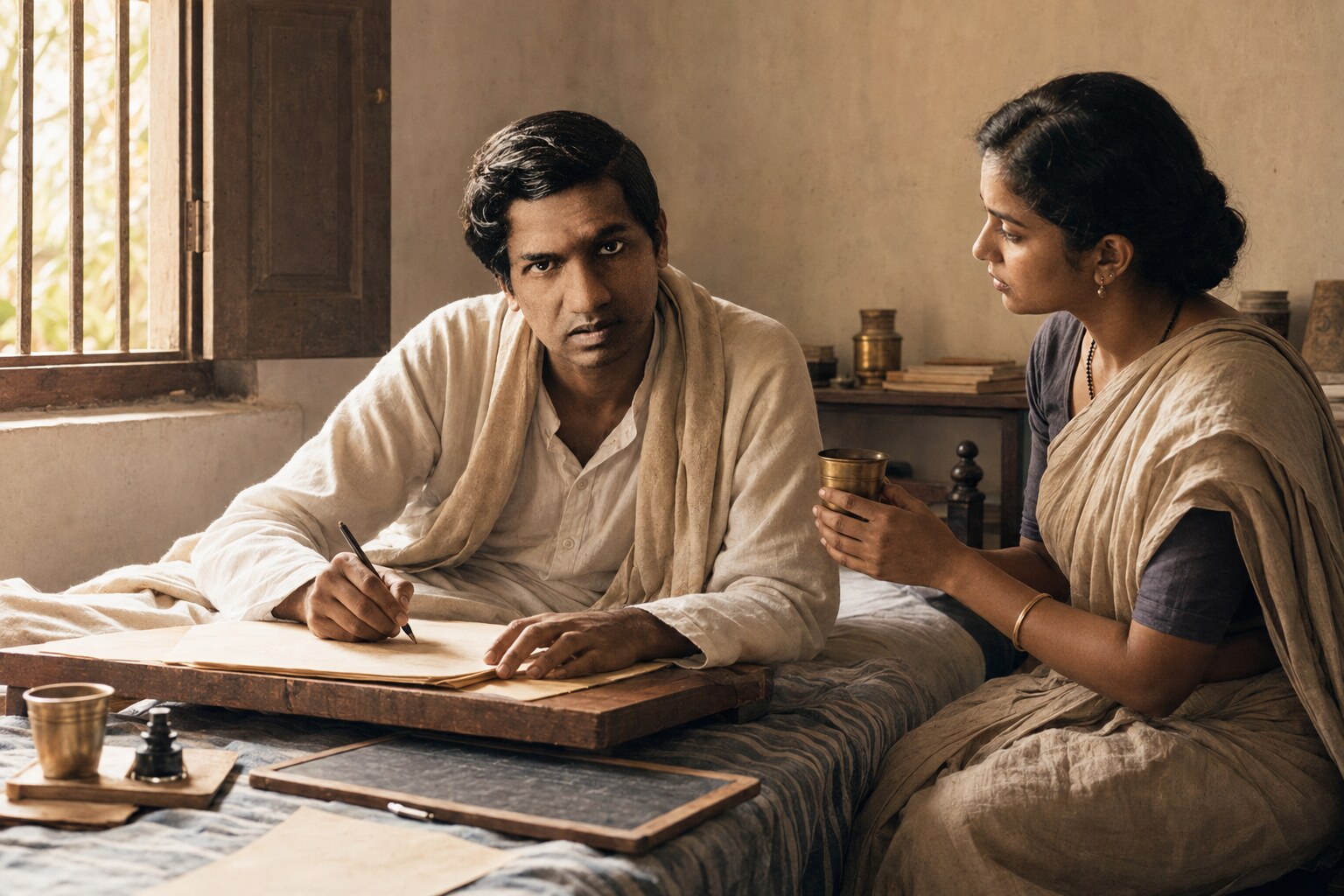 AI-generated historical reconstruction inspired by Ramanujan’s final mathematical work and Janaki’s care during his last illness. It is an illustration, not an authentic image of a particular moment.
He included examples of these mysterious functions. Their importance was not fully understood at the time, but they later became an influential area of mathematical research with connections extending far beyond the problems Ramanujan had originally considered.9, 10
Srinivasa Ramanujan died on 26 April 1920, aged thirty-two.
His work, however, was far from exhausted. Hardy and other mathematicians edited and studied the notebooks he had left behind. In 1976, the American mathematician George Andrews discovered approximately 138 written sheets among the papers of G. N. Watson in Trinity College’s Wren Library.
The collection became known as Ramanujan’s “lost notebook.” It contained hundreds of results from the final period of his life, including extensive work connected with mock theta functions. Mathematicians have spent decades proving, interpreting and extending the formulas preserved there.1, 11
Ramanujan’s story is sometimes described as the triumph of an isolated genius. But he did not travel the entire path alone. Indian teachers, officials and patrons protected his work when poverty threatened it. His mother’s faith shaped his spiritual world. Janaki shared the hardships of his brief adult life and cared for him during his final illness. Hardy, Littlewood and Neville helped carry his notebooks into the international mathematical community.
Their support did not create his genius. It prevented that genius from remaining unseen.
DataTorch Closing Thought
Ramanujan believed that Namagiri inspired his mathematical insights. Yet every insight still had to pass through his attention, memory, calculation and written work. Faith gave his search meaning, discipline gave it form, and courage carried a poor clerk’s notebooks across the world.
What he experienced in dreams belongs to his spiritual testimony. What he preserved in formulas belongs to mathematical history.
His life also reminds us that even an exceptionally gifted and deeply spiritual person can pass through profound mental anguish. Such suffering does not cancel faith, genius or human worth. Ramanujan survived his darkest recorded moment, received great honours soon afterwards and continued creating mathematics even as his body weakened.
Srinivasa Ramanujan’s life reminds us that extraordinary ability may appear far from recognised institutions. Sometimes the world’s task is not to create the light, but to notice it, protect it and give it room to shine.
Sources
- Trinity College Library: Remembering Ramanujan.
- Trinity College Archives: Letters from Ramanujan to G. H. Hardy.
- MacTutor History of Mathematics: Srinivasa Ramanujan.
- Royal Society: Revisiting Ramanujan.
- E. H. Neville, “Srinivasa Ramanujan—From Obscurity to Fame”.
- G. H. Hardy, Ramanujan: Twelve Lectures on Subjects Suggested by His Life and Work.
- S. R. Ranganathan, Ramanujan: The Man and the Mathematician.
- P. K. Srinivasan, ed., Ramanujan: Letters and Reminiscences, 1968.
- Trinity College: Ramanujan’s final letter on mock theta functions.
- Royal Society: Asymptotics and Ramanujan’s mock theta functions.
- George E. Andrews and Bruce C. Berndt, Ramanujan’s Lost Notebook.
- R. A. Rankin, “Ramanujan as a Patient,” Proceedings of the Indian Academy of Sciences (Mathematical Sciences) 93 (1984), 79–100.
- D. A. B. Young, “Ramanujan’s Illness,” Notes and Records of the Royal Society of London 48 (1994), 107–119.