Saint George: The Dragon, the Widow’s Pillar and the Captive Youth
How three medieval stories made Saint George a symbol of courage, dignity, deliverance and good overcoming evil.
The Martyr Behind the Legends
Saint George is one of the most widely recognised Christian saints. He is usually shown as a soldier on a white horse, holding a spear above a defeated dragon.
Among the many traditions associated with George, three became especially memorable. One concerns a city living in fear. Another centres on a poor widow whose gift was rejected. The third tells of a captive youth carried home to his mother.
The Dragon and the Frightened City
The dragon story was widely circulated in Western Europe through Jacobus de Voragine’s thirteenth-century collection known as The Golden Legend.3
According to that version, a dragon lived near a city called Silene in Libya. Its breath threatened the people, who first gave it sheep. When the supply of sheep became insufficient, they began choosing human victims by lot. Rich and poor were included.
One day, the lot fell on the king’s daughter. The king offered his wealth in exchange for her life, but the people reminded him that their own children had already been lost. The princess was therefore taken outside the city and left near the dragon’s dwelling.
George arrived while she was waiting. She warned him to leave before the dragon appeared. He remained. When it came towards them, the story says that George made the sign of the cross, rode against it and struck it with his spear.
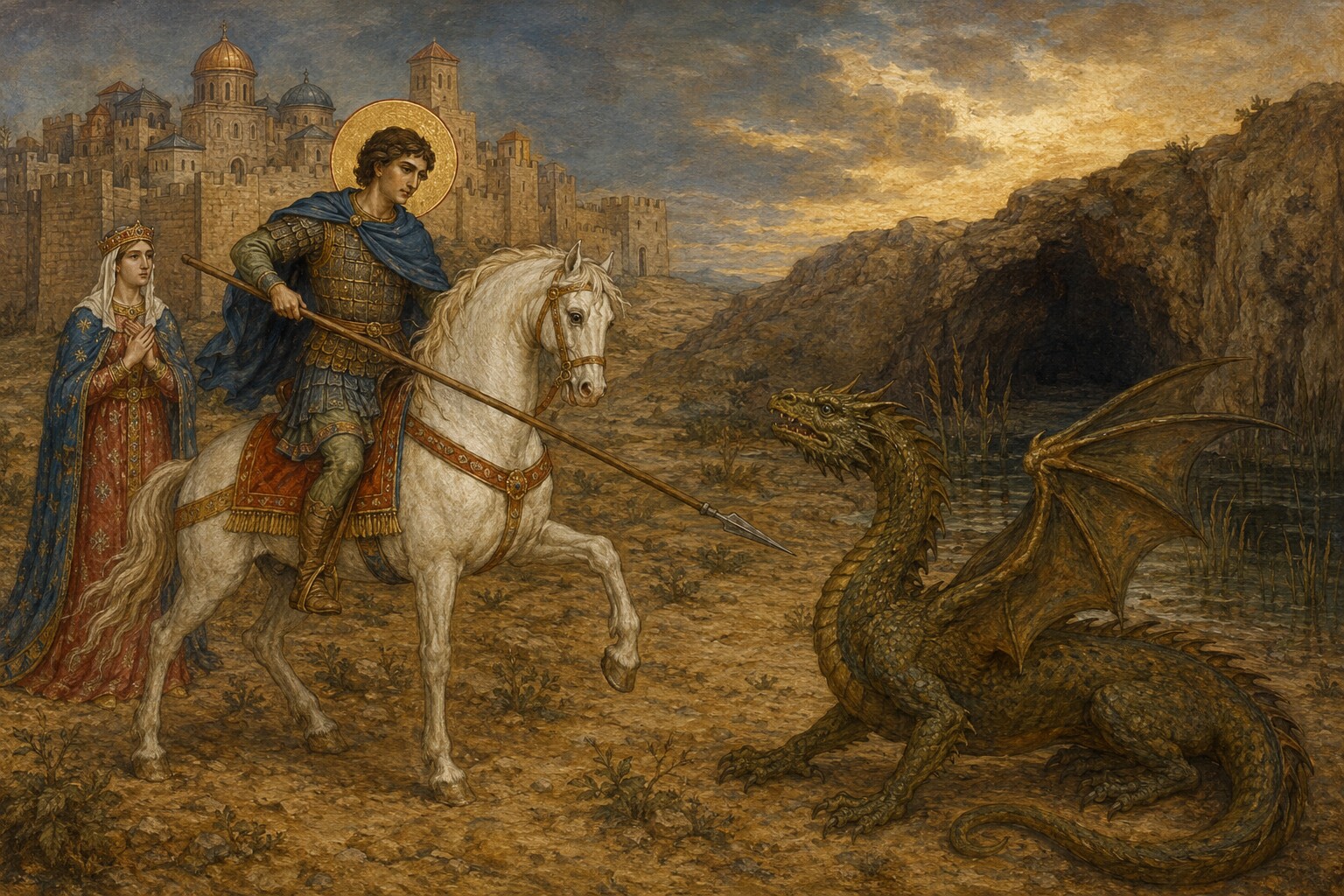 AI-generated interpretation of the medieval dragon legend. It is an illustration of a later tradition, not an authentic image of a historical event.
The dragon was wounded but not yet killed. George then asked the princess for her girdle. She placed it around the dragon’s neck and led the subdued creature towards the city. The animal that had controlled the city through fear now followed the person who had been intended as its victim.
The legend continues with the conversion and baptism of the people. George killed the dragon, and the king offered him a large reward. He refused it and directed that the money be given to the poor.3
The importance of the dragon lies in the way later generations understood it. The animal came to represent destructive evil, while George represented the divine courage to confront it. The princess leading the defeated dragon added another image: a vulnerable person was no longer being controlled by fear.
The Widow’s Pillar
In a medieval collection of miracles attributed to Saint George, a ruler decided to rebuild a church in the town associated with the saint and his relics. A poor widow wanted to contribute a pillar.7
Her gift was rejected. In some later retellings, the problem was that she could not arrange for the large stone to be carried with the other building materials. The widow had made a costly offering, but the people managing the work did not consider it practical or important enough to accept.
According to the miracle account, the grieving widow appealed to Saint George. An armed horseman appeared to her and asked why she was distressed. After hearing her story, he marked the pillar with an instruction that it should be placed in a particular position inside the church.
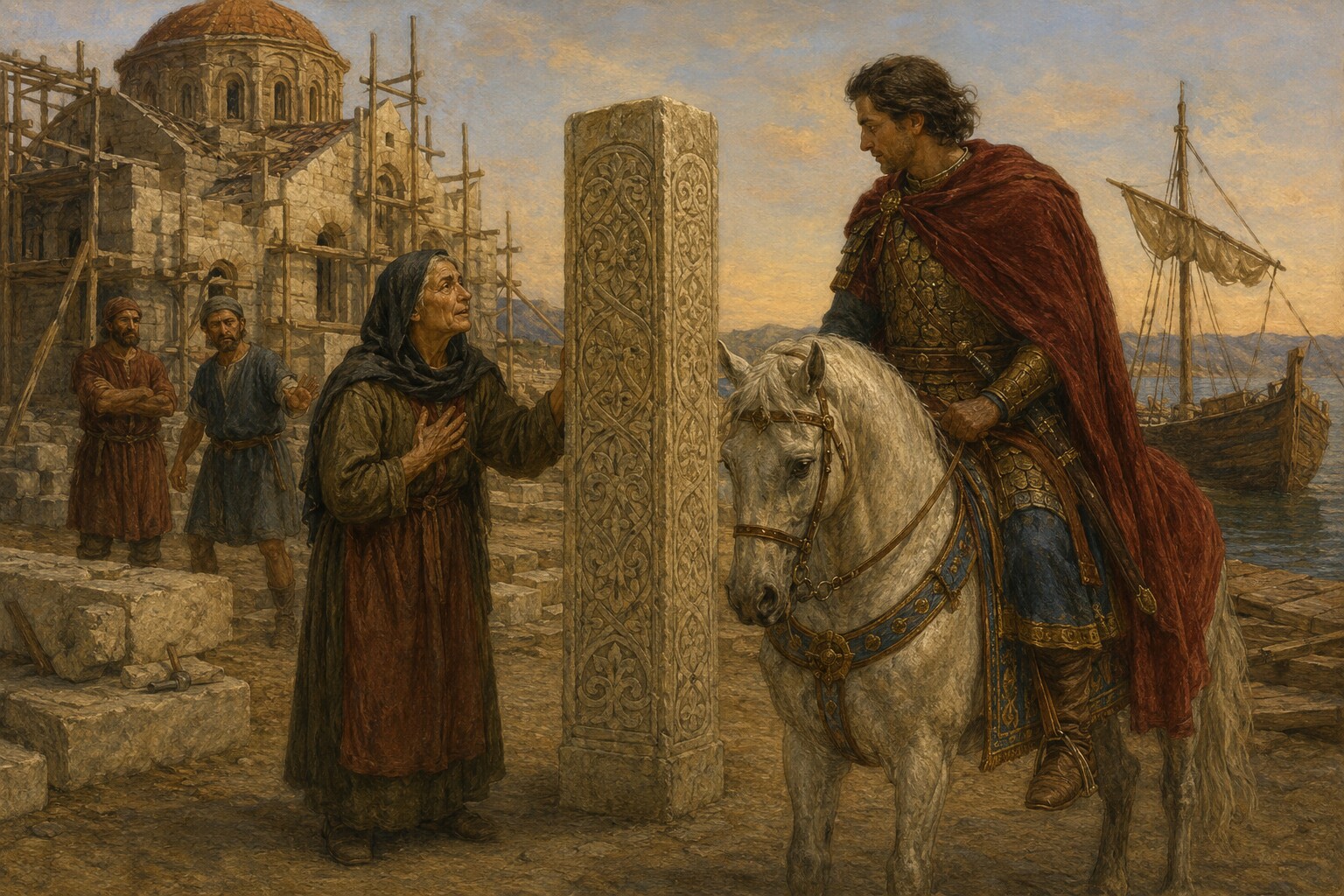 AI-generated interpretation of the medieval story of the widow’s pillar. The widow and her rejected gift remain the centre of the scene.
The account says that the pillar was then found at the church before the other materials arrived. Its inscription ensured that the widow’s gift could neither be ignored nor passed off as somebody else’s contribution. The pillar was given its place in the building, and the woman who had first been dismissed was publicly remembered.
This is a religious story preserved in medieval manuscripts. Yet its human concern is clear. The miracle is not told for the benefit of a ruler or wealthy donor. It centres on a poor woman whose sincere contribution was rejected.
In the dragon legend, George protects someone whom a city is prepared to sacrifice. In the pillar story, he stands beside someone whom society has overlooked. Courage appears here not as combat, but as the restoration of dignity.
The Captive Youth of Mytilene
Another group of posthumous miracle stories shows Saint George rescuing young people from captivity. The details vary between versions. One of the best known concerns a widow’s son from Mytilene, on the island of Lesbos.4
According to this tradition, raiders from Crete attacked Mytilene during the feast of Saint George. Among those taken captive was the widow’s young son. He was carried to Crete and made to serve the emir as a cupbearer.
The story places the mother at the centre of the waiting that followed. For a year she prayed for her son’s return. On the next feast of Saint George, while the youth was serving wine to his captor, George appeared on a white horse. The account says that he lifted the young man onto the horse and carried him across the sea to his mother. The cup was still in the youth’s hand when he reached home.4
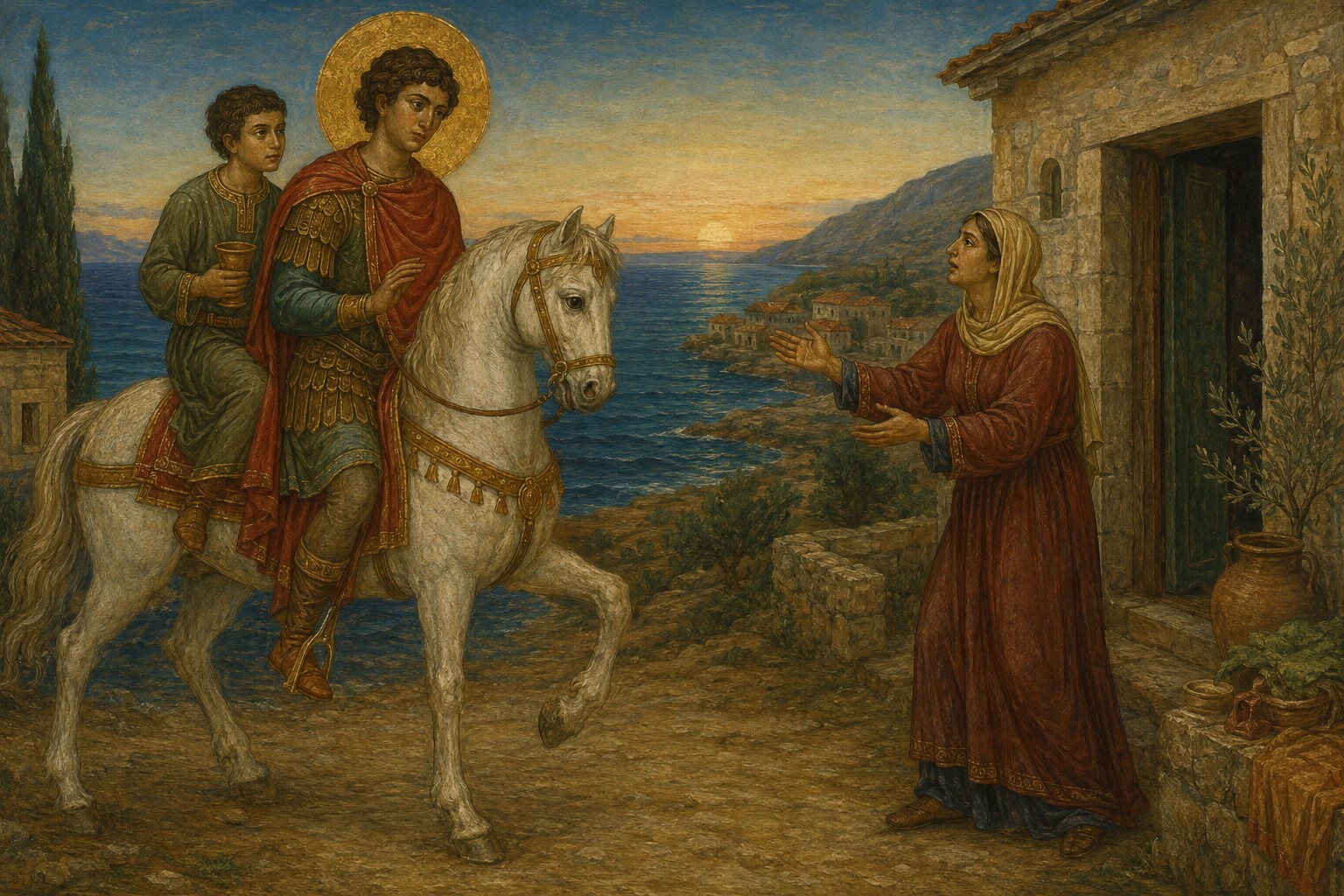 AI-generated interpretation of the Byzantine tradition of Saint George returning the captive youth of Mytilene. The scene represents deliverance and reunion.
This unusual detail made the story easy to recognise in art. A mid-thirteenth-century icon now in the British Museum shows George on a white horse with a much smaller figure seated behind him. The young man holds a glass of red wine, and the sea appears beneath the horse. It does show that the account had become important enough to be preserved visually.5
The miracle was told in communities that knew the reality of raids, separation and captivity. Its central image is not a defeated enemy but a reunion: a young captive is released, and a mother’s long waiting ends.
Three Stories and One Enduring Symbol
The martyr honoured at Lydda, the knight who faced a dragon, the defender of a widow and the rescuer of a captive youth belong to different layers of Saint George’s tradition.
Read together, however, the stories explain why the image of George travelled across countries and centuries. The dragon story gave people a picture of good confronting evil. The widow’s pillar expressed the hope that the dignity of an overlooked person would be recognised. The captive youth represented deliverance and the restoration of a broken family.
The stories also broaden the meaning of courage. It is not only the courage to fight a visible enemy. It is the courage to stand beside a person whom others are willing to sacrifice, to honour a gift that others dismiss, and to seek the freedom of someone who has been taken away.
DataTorch Closing Thought
Not every dragon has scales, not every captivity has chains, and not every rejected offering is a pillar.
The Saint George traditions also place prayer at the heart of hope. The captive youth’s mother prayed through a year of separation, while the widow turned to prayer after her sincere offering was rejected. Their stories present prayer not as an escape from hardship, but as an act of trust when human efforts appear insufficient.
Prayer does not always remove suffering or bring the answer we expect. Yet, for believers, consistent prayer can draw a person closer to God, bring peace amid uncertainty, and give courage, patience and clarity to continue a worthy mission. Its power is found not only in extraordinary deliverance, but also in the quiet strength to confront evil without hatred, protect the vulnerable and persevere in doing what is right.
Good overcomes evil not only in dramatic victories. It also happens whenever faith strengthens courage, dignity is restored and someone is helped towards freedom and home.
Sources
- Vatican News, “St. George, Martyr”. Overview of the early cult, the apocryphal status of the Passio, later devotion and the symbolism of the dragon tradition.
- Christopher Walter, “The Origins of the Cult of Saint George,” Revue des études byzantines 53 (1995). Scholarly study used for the early cult and the limits of historical reconstruction.
- Jacobus de Voragine, “The Golden Legend: St. George,” Fordham University Medieval Sourcebook. Medieval text used for the selected dragon narrative.
- Piotr Grotowski, “The Legend of St. George Saving a Youth from Captivity and Its Depiction in Art,” Series Byzantina 1 (2003). Study of the different captive-youth traditions and their iconography.
- British Museum, “Icon with St George and the youth of Mytilene,” museum number 1984,0601.1. Object record for the mid-thirteenth-century icon.
- University of Oxford, Cult of Saints in Late Antiquity database, E04385. Seventh-century papyrus fragments demonstrating the early circulation and variation of legendary accounts of George.
- Roger Pearse, “Aufhauser’s discussion of some miracles of St George”. English summary of J. B. Aufhauser’s study of the medieval Miracula S. Georgii, used cautiously for the widow’s-pillar manuscript tradition.
Images: The title and supporting images were generated for DataTorch as artistic interpretations of medieval Saint George traditions. They are not authentic images of historical events. The illustrations contain no third-party assets requiring attribution.