Joan of Arc: Conscience, Courage and the Cost of Conviction
A Question with Her Life Behind It
In February 1431, nineteen-year-old Joan of Arc sat before churchmen in Rouen and faced a question that could trap a trained theologian: Did she know whether she was in God's grace?
“If I am not, may it please God to put me in it; if I am, may it please God to keep me there.” — Joan of Arc3
It was a careful answer from a young prisoner whose words were being examined for heresy. Only two years earlier she had been an unknown village girl. Since then she had crossed hostile territory, gained access to the French royal court, entered a besieged city, been wounded in battle and stood near Charles VII at his coronation.
Now she was a captive, and words rather than weapons would decide her fate.
How did she come to that courtroom — and why did the convictions that carried her so far eventually cost her life?
The Voices and a Mission No One Expected
Joan was born around 1412 at Domrémy, a village in a France divided by the Hundred Years' War. Her family were farmers. Nothing in her social position suggested that she would enter royal or military affairs.
At her 1431 trial, Joan said that she had been about thirteen when she first experienced what she called a “voice.” She later identified the guidance she received with St Michael, St Catherine and St Margaret. She became convinced that she had a mission from God: to assist the French cause and help Charles, then the uncrowned heir, reach his coronation.1
 AI-generated historical illustration of the young Joan at Domrémy, representing the experience she later described in her testimony; not an authentic image of Joan or the event.
Here history and faith must be distinguished. The surviving evidence establishes that Joan reported these experiences and believed them to be divine. Historical research by itself cannot establish their supernatural origin.
What history can follow is what she did because of that conviction.
Joan sought the help of Robert de Baudricourt, the commander at Vaucouleurs. She was initially rejected. She returned. Eventually she obtained an escort and travelled through dangerous territory to reach Charles at Chinon in 1429. Her claims were examined by churchmen at Poitiers before she was allowed to accompany the French effort to relieve Orléans.3
Conviction had now become action.
From an Unknown Girl to Orléans and Reims
Joan entered Orléans on 29 April 1429, while the city was under English siege. During the fighting that followed, she was not merely a distant symbol. On 7 May, during the assault on the fortified position of Les Tourelles, she was wounded but returned to the action. The next day the English withdrew, bringing the siege to an end.2
The victory transformed Joan's public importance. French forces continued their campaign along the Loire, and the way towards Reims gradually opened. On 17 July 1429, Charles VII was crowned in Reims Cathedral, with Joan present.3
For a teenager who had struggled even to persuade a local commander to listen to her, the scene was extraordinary. Yet it was not the end of her story.
Military success did not make Joan untouchable. On 23 May 1430, during fighting at Compiègne, she was captured by Burgundian forces. After months in captivity she was transferred into English hands and taken to Rouen.3
The battlefield had tested whether Joan would act on her conviction. The courtroom would test whether she would retreat from it.
The Trial: When Conviction Became the Accusation
Proceedings began at Rouen in January 1431. The principal judge was Pierre Cauchon, Bishop of Beauvais; Jean Le Maistre, representing the inquisitorial authority, later joined the case. Numerous clerics and theologians participated as assessors. It was an ecclesiastical trial, conducted in English-controlled Rouen against a prisoner whose military and political role had made her an important enemy of the English cause.13
 AI-generated historical illustration of Joan; a reconstruction for DataTorch, not an authentic image.
It is therefore too simple either to say that Joan was executed merely because she was Christian or to say that she was executed for “hearing voices.” The formal case was one of heresy, built from a much wider examination of her words and actions. Her claimed revelations and certainty about their divine source, her willingness to submit those claims to the judgment of the Church on earth, her wearing of male clothing, and other aspects of her conduct were all scrutinised.1
Joan herself did not present herself as an opponent of Christianity. During the proceedings she said that if anything she had said or done were contrary to the Christian faith, she would not uphold it. At the same time, she resisted being forced to deny what she believed God had commanded her to do. That tension — between her certainty about the voices and the tribunal's claim to judge such revelations — became central to the case.1
The interrogations repeatedly returned to her voices. They also returned to her clothing. Joan had adopted male military dress when travelling and campaigning and continued to wear male clothing in captivity. The surviving trial record shows that the judges treated the issue as religiously significant, while Joan linked her choice to what she believed God required of her.1
On 24 May 1431, at Saint-Ouen in Rouen, Joan faced the threat of immediate execution and made an abjuration. Her sentence was reduced to imprisonment. Within days, however, she was again wearing male clothing and she reaffirmed the voices she had previously renounced. Accounts of exactly why she resumed male clothing are not fully consistent, so it would be unsafe to give one explanation as certain fact.
For the tribunal, the decisive issue was relapse. Having abjured and then returned to positions the court regarded as heretical, Joan was formally declared a relapsed heretic and handed over to the secular authority.1
The distinction matters. Joan was not condemned for rejecting Jesus Christ. The trial record itself shows how frequently she spoke of God, Jesus and the Christian faith. The accusation was that some of her particular claims, actions and refusal to submit them as the tribunal demanded were contrary to the faith. Whether that tribunal judged her justly would itself later be put on trial.
30 May 1431: The Final Morning
On the morning of 30 May, Joan received Holy Communion in prison. She was then taken to the Old Market Square in Rouen for execution.
Later testimony gathered during the proceedings that revisited her case described her asking for a cross to be held before her. As the fire was lit, witnesses recalled her repeatedly calling on the name of Jesus.3
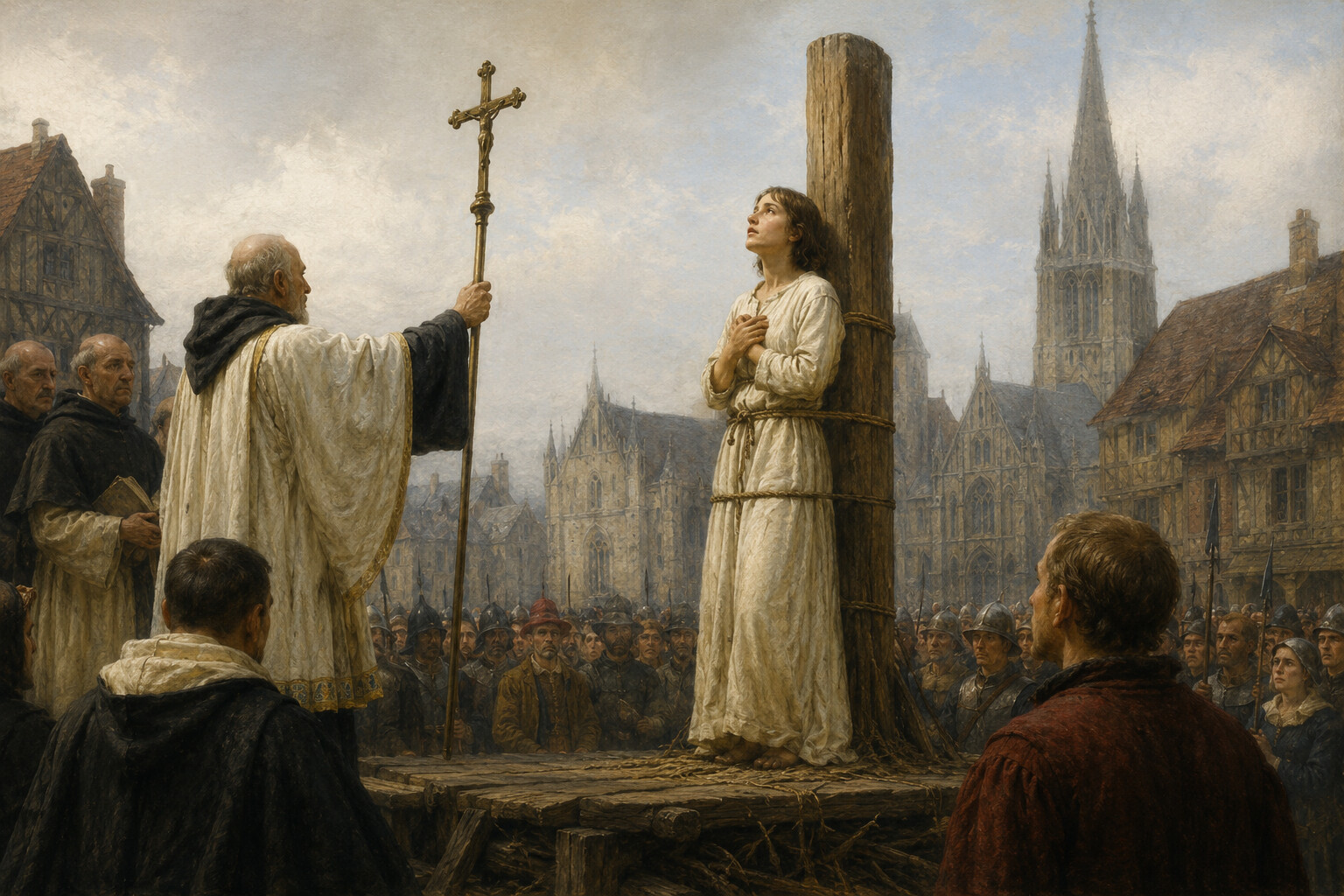 AI-generated, non-graphic historical illustration of Joan's final moments at Rouen, based on later testimony about the cross held before her; not an authentic image of the execution.
Joan of Arc died at about nineteen years of age.
The authorities could end her life. They could not end the question of whether the judgment against her had been just.
When the Judgment Was Judged
About twenty-five years later, Joan's case was formally re-examined. A Trial of Nullity, opened under the authority of Pope Callixtus III, gathered testimony from many witnesses and consulted theologians. On 7 July 1456, it solemnly declared the earlier condemnation null and void.3
This point is essential. Joan's later recognition as a saint did not simply appear five centuries after an unquestioned 1431 judgment. The condemnation itself had already been annulled in the fifteenth century.
On 16 May 1920, Pope Benedict XV canonised Joan of Arc. The Holy See's canonisation decree, Divina disponente, presented her as an example of fidelity to God's commands and referred to her death as unjust.4
The girl once condemned as a relapsed heretic was now formally numbered among the saints of the Catholic Church.
Conscience, Courage and the Cost of Conviction
Joan's story can be misunderstood if its lesson is reduced to “always follow your inner voice.” A strong conviction is not proof that a belief is true. Conscience requires honesty, discernment, knowledge and a willingness to be corrected.
But Joan's life raises another uncomfortable question: What happens when a person has tested a conviction as sincerely as she can, yet obedience to that conviction becomes costly?
Her story shows that courage is not simply confidence. Joan experienced rejection before she was heard, danger after she was believed, captivity after victory, and finally a court that demanded she renounce claims she considered fundamental to her mission.
It also teaches humility about human judgment. Courts, institutions, experts and majorities are necessary, but they are still made up of human beings working within the pressures and assumptions of their time. Authority deserves serious respect; it does not make every human decision infallible. The later nullification of Joan's condemnation is a striking reminder that a legal judgment and the truth about a person are not always the same thing.
Nor should we romanticise the cost. Rehabilitation came twenty-five years after Joan's death. Canonisation came centuries later. A later correction could restore her reputation; it could not give a nineteen-year-old woman her life back.
That is perhaps the hardest lesson in her story: doing what we sincerely believe to be right does not guarantee safety, success or immediate vindication. Courage sometimes means acting responsibly without those guarantees.
Joan expressed the centre of her own loyalty in a few words preserved from the trial:
“We must serve God first.” — Joan of Arc3
For a Christian reader, those words speak of obedience to God above fear. For readers of any belief, the wider challenge remains: examine what you believe, test it honestly, listen seriously to correction — and when conscience still requires a responsible course of action, do not let fear alone make the decision for you.
DataTorch Closing Thought
Courage does not begin when every doubt disappears. It begins when we test what we believe, recognise what we must do, and take the next responsible step even when we feel too small for the task.
Sources
- Fordham University, Internet Medieval Sourcebook, The Trial of Joan of Arc. English translation of the condemnation-trial record; used for Joan's recorded answers, her reported voices, the Church-submission issue, clothing, abjuration and the formal finding of relapse.
- City of Orléans, historical material on Joan of Arc and the siege of 1429. Used for the Orléans chronology, including the 7 May assault at Les Tourelles, Joan's wounding and the end of the siege on 8 May.
- Benedict XVI, General Audience, 26 January 2011, “Saint Joan of Arc,” Holy See. Used for the historical value of the two trial records, Joan's reported vocation, Poitiers and Reims chronology, her trial and final moments, the 1456 nullity judgment, and the verified quotations.
- Benedict XV, Divina disponente, 16 May 1920, Holy See. Canonisation decree of Joan of Arc; used to verify the exact canonisation date and the Church's description of Joan's innocence, fidelity and unjust death.
- Bibliothèque nationale de France, Jeanne d'Arc. Supporting institutional source on the documentary record and historical importance of the condemnation and nullity trials.