Florence Nightingale: The Calls That Led Her to the Lamp
On 7 February 1837, Florence Nightingale was sixteen years old and living at her family home in England. She later recorded that on that day God spoke to her and called her to His service.1
The call did not tell her what work to do. There was no hospital, no group of nurses and no lamp—only a conviction that her life should be used for a purpose beyond comfort and social position.
It would take many years before the direction became clear.
A Call Without a Map
Florence was born in 1820 into a wealthy English family. Her father taught her languages, history, philosophy and mathematics. Her family expected her to marry and manage a respectable household.
Florence wanted useful work. She visited poor families, studied hospitals and became increasingly interested in nursing. The choice disturbed her family. In nineteenth-century Britain, hospital nursing was often poorly trained, badly organised and considered unsuitable for a woman of her social position.
Her first sense of calling did not lead immediately to action. It was followed by waiting, family resistance, study and uncertainty.
During a journey through Egypt in 1850, the spiritual question returned. In a private diary entry dated 7 March, she recorded that God had asked whether she would do good for Him alone, without reputation. It was an exacting question. Was she willing to serve even if the work brought no admiration?
Later that year, she visited the Protestant deaconess community at Kaiserswerth in Germany, where women were trained to care for the sick and poor. She returned in 1851 for practical nursing training. In 1852, she again understood herself as being called to help deliver people from suffering.12
These experiences did not give her a complete plan. They gradually joined faith to preparation.
The Work Begins Before the War
In 1853, Florence became superintendent of the Institution for the Care of Sick Gentlewomen in London. This was not yet the great public mission associated with her name. It was, however, an important test of her ability.
She had to manage staff, patients, finances and daily problems. Compassion alone could not run an institution: supplies had to be obtained, duties assigned and standards maintained.
The young woman who had spent years asking what God wanted her to do was now learning how to make care practical.
Then war created a need on a far larger scale.
Two Letters Cross
In 1854, reports reached Britain describing the suffering of British soldiers in the Crimean War. Military hospitals lacked nurses, equipment and basic supplies. Florence decided to offer her service.
She wrote to Elizabeth Herbert, wife of the Secretary at War, offering to lead a nursing expedition. At almost the same time, Sidney Herbert wrote asking Florence to organise nurses for the military hospitals. The two letters crossed in the post.3
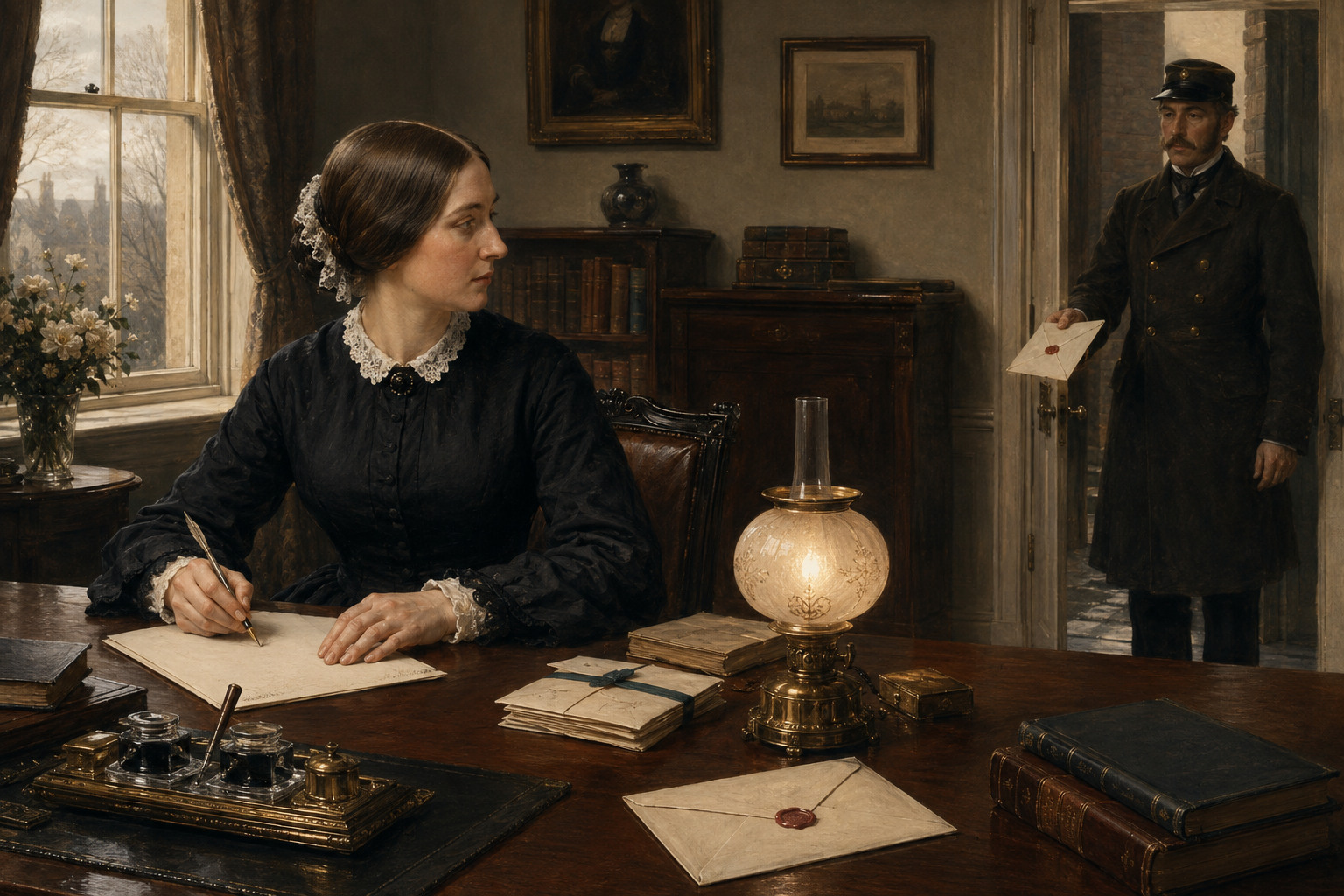 AI-generated historical interpretation of the two letters that crossed in October 1854. It represents the documented episode but is not an authentic image of the moment.
The coincidence did not replace the years of preparation. It revealed why those years mattered. When the opportunity arrived, Florence had enough training and administrative experience to answer it.
On 21 October 1854, she left London with a team of 38 nurses. They reached Scutari, near Constantinople—now Istanbul—in early November.2
Care in the Corridors of Scutari
The hospital at Scutari was crowded with sick and wounded men and lacked beds, blankets, food, clothing and medical necessities. Many patients suffered from infectious diseases as well as battle wounds. Some officers were initially suspicious of the nurses.
Florence and her team did not solve every problem alone. They worked within a larger and sometimes resistant military system. They organised nursing duties, kitchens, laundry, clothing and supplies. They wrote letters home for soldiers and helped them send money to their families. Reading rooms and other forms of support were later introduced.24
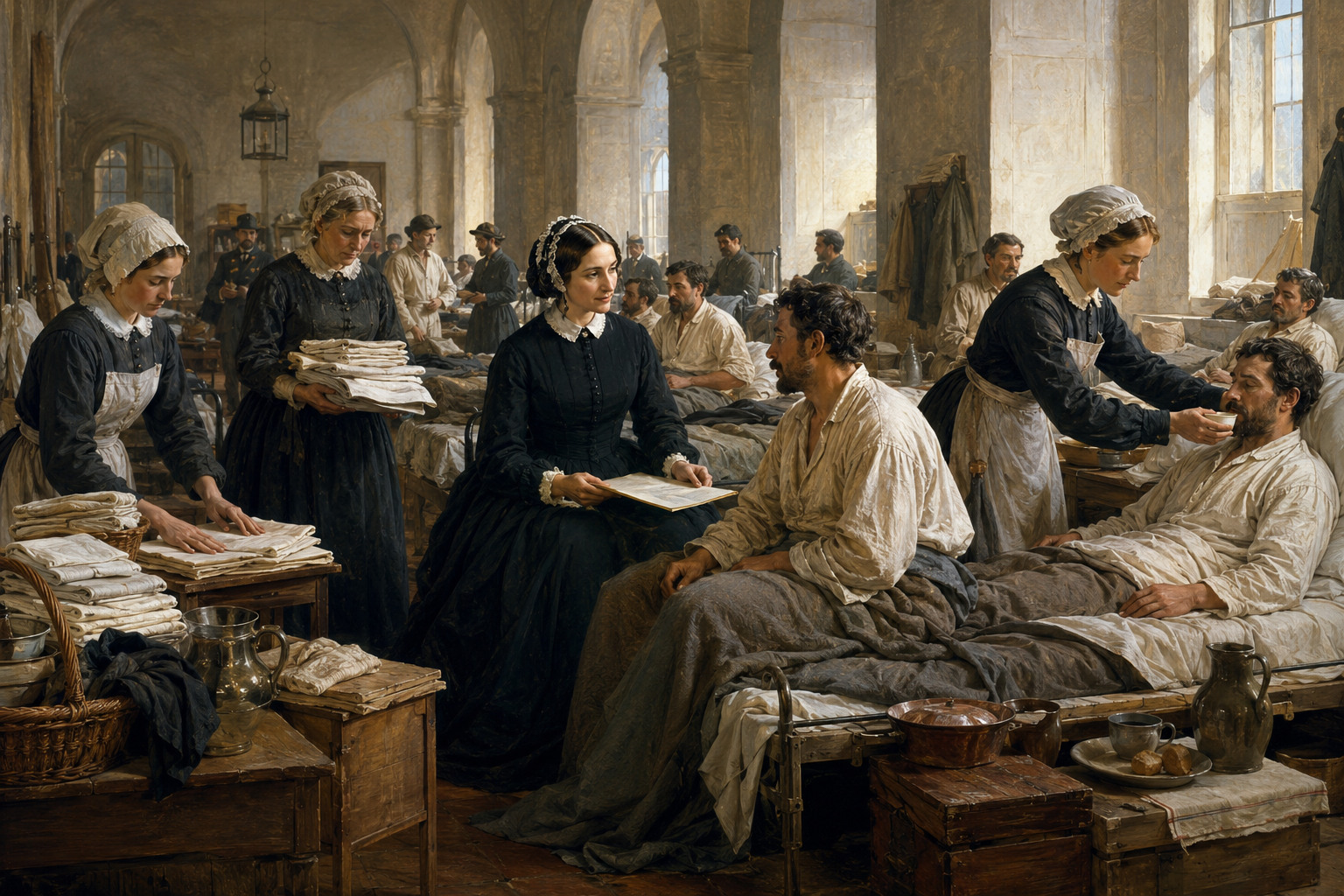 AI-generated historical interpretation of team-based nursing and organisational work at Scutari. It is based on documented activities, not a reconstruction of one recorded moment.
Their care included acts easily lost in official reports. Nurse Sarah Anne Terrot remembered Florence distributing shirts, speaking gently to the sick and giving brandy to a dying soldier before walking to the mortuary late at night. Terrot described her as tired and worn, yet firm and kind.5
This was the nursing work behind the famous lamp: noticing an unmet need, bringing comfort to a frightened patient, and continuing when the corridors were quiet.
The Report That Created an Image
On 8 February 1855, The Times published an admiring report about Nightingale:
“She is a ‘ministering angel’ without any exaggeration in these hospitals, and as her slender form glides quietly along each corridor, every poor fellow’s face softens with gratitude at the sight of her. When all the medical officers have retired for the night and silence and darkness have settled down upon those miles of prostrate sick, she may be observed alone, with a little lamp in her hand, making her solitary rounds.”6
The description was enthusiastic Victorian journalism, not a neutral assessment. Yet it captured her willingness to remain close to suffering when the hospital became silent.
Two years later, Henry Wadsworth Longfellow gave the scene poetic form in Santa Filomena:
Lo! in that house of misery
A lady with a lamp I see
Pass through the glimmering gloom,
And flit from room to room. — Henry Wadsworth Longfellow7
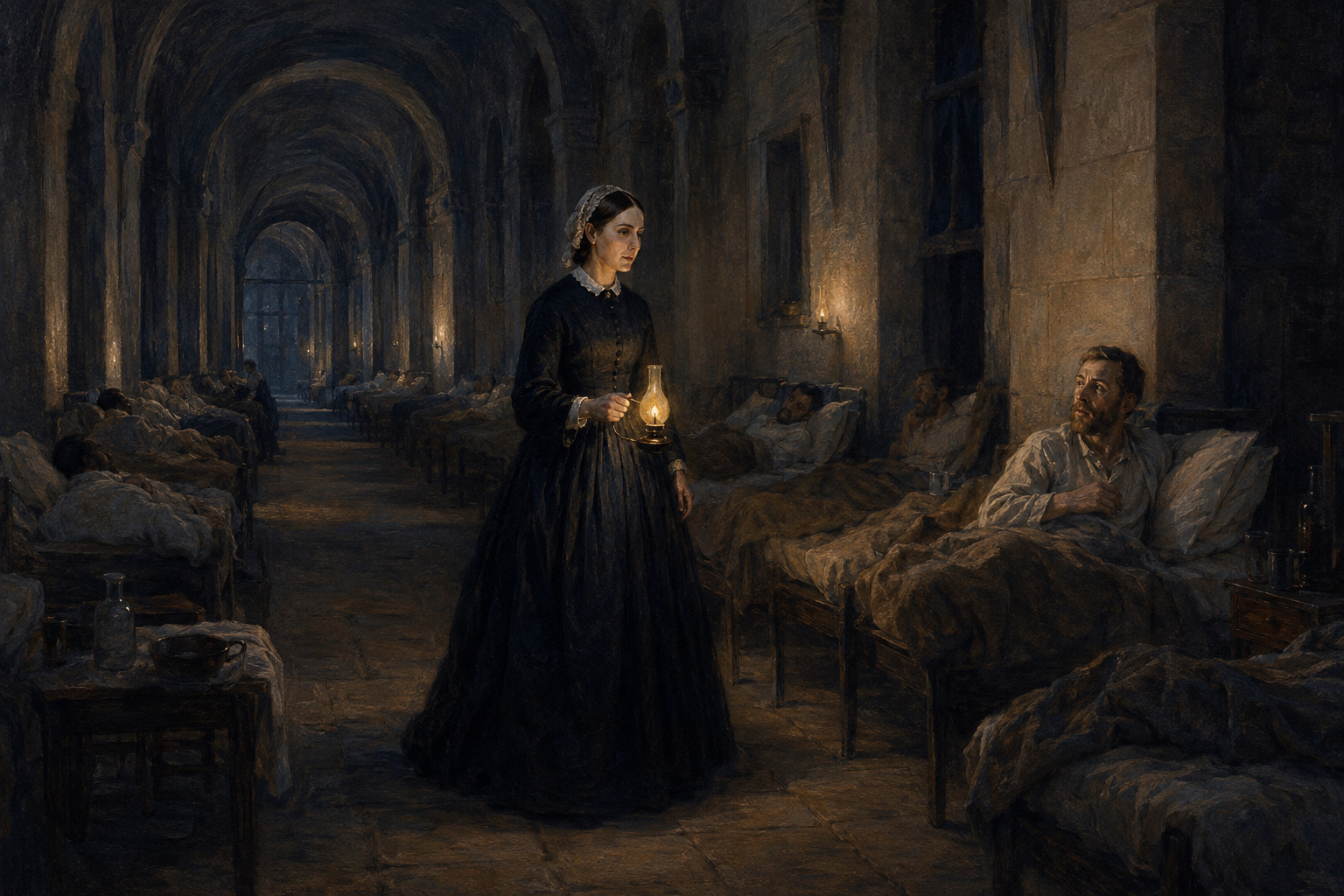 AI-generated historical interpretation of the night rounds remembered in the Lady with the Lamp tradition. It is an artistic illustration, not an authentic image of the event.
The poem made “the Lady with the Lamp” an enduring image. But Nightingale was part of a nursing team, and lasting improvement also depended on doctors, orderlies, engineers, officials and the government Sanitary Commission.
The fall in mortality at Scutari cannot honestly be credited to one person. The Sanitary Commission’s work on drains, ventilation and cleanliness was crucial. Nightingale herself did not initially understand the full importance of the hospital’s defective sanitation. What matters is that she later followed the evidence and made sanitary reform central to her work.4
When the Lamp Became Data
After returning to Britain in 1856, Florence could have remained only a celebrated wartime nurse. Instead, she studied what had gone wrong.
Working with statistician William Farr and other reformers, she examined military sickness and death records. Her tables, reports and diagrams showed that preventable disease had killed far more soldiers than battle wounds. Evidence became another form of service.
She pressed for reform of military hospitals and public health. Her book Notes on Nursing explained the importance of ventilation, cleanliness, food, quiet and careful observation. In 1860, the Nightingale Training School opened at St Thomas’ Hospital, helping to establish nursing as a trained and respected profession.48
Florence’s religious thought was complex and did not always follow the conventional opinions of her time. But she consistently understood her abilities as something to be used in God’s service. Prayer did not prevent her from studying evidence. Faith did not excuse poor planning. For her, service required both moral purpose and disciplined work.
The Light Behind the Lamp
The lamp became famous because people could see it. The years that placed it in Nightingale’s hand were less visible.
They included an early call without clear instructions, long resistance from her family, years of study, practical training, administrative work and the courage to accept responsibility when two letters crossed in the post. They also included mistakes, opposition and the humility to learn from evidence.
Her story does not suggest that every calling arrives as a voice or that every sincere prayer produces immediate success. It shows something quieter: a sense of purpose may take years to understand, and its meaning often becomes clear through preparation and service.
DataTorch Closing Thought
Florence Nightingale did not receive a complete map when she first believed that God had called her. The direction became clearer as prayer was followed by study, waiting by preparation, and compassion by practical work.
The lamp was a beautiful symbol, but it was not the whole light. The deeper light came from a life that joined faith with responsibility, tenderness with discipline, and prayer with evidence.
A worthy calling may begin as a quiet conviction. It becomes fruitful when a person patiently develops the knowledge, character and courage needed to answer it.
Sources
- Susan Rakoczy, “Florence Nightingale: Discernment as trusting experience,” HTS Theological Studies 74(3), 2018. Scholarly study based on Nightingale’s private notes and spiritual writings; used for the 1837, 1850 and 1852 calls and the long discernment of her vocation.
- Florence Nightingale Museum, “Florence Nightingale”. Institutional biography used for her training, the nursing expedition and the work at Scutari.
- Oxford Dictionary of National Biography, “Nightingale, Florence (1820–1910)”. Used for the crossed letters and the transition from private preparation to the official Crimean mission.
- National Army Museum, “Florence Nightingale: The Lady with the Lamp”. Used for conditions at Scutari, the wider team, the Sanitary Commission, statistics and later reform.
- Karen Attar, University of London, “What an eyewitness account reveals about the Lady with the Lamp”. Discussion of nurse Sarah Anne Terrot’s eyewitness memoir of Scutari.
- The National Archives (UK), “Florence Nightingale: Why do we remember her?”. Reproduces the contemporary Times report published on 8 February 1855.
- Henry Wadsworth Longfellow, “Santa Filomena,” The Atlantic Monthly, November 1857. Original publication of the poem that helped establish the Lady with the Lamp image.
- Florence Nightingale, Notes on Nursing: What It Is, and What It Is Not (1859/1860). Primary work demonstrating her practical approach to ventilation, cleanliness, food, quiet and observation.
Images: The title and supporting illustrations were generated for DataTorch as artistic historical interpretations. They are not authentic photographs of Nightingale or the specific events shown. The illustrations contain no third-party assets requiring attribution.