Dominic Savio: The Young Saint Who Found Holiness in Joy and Daily Duty
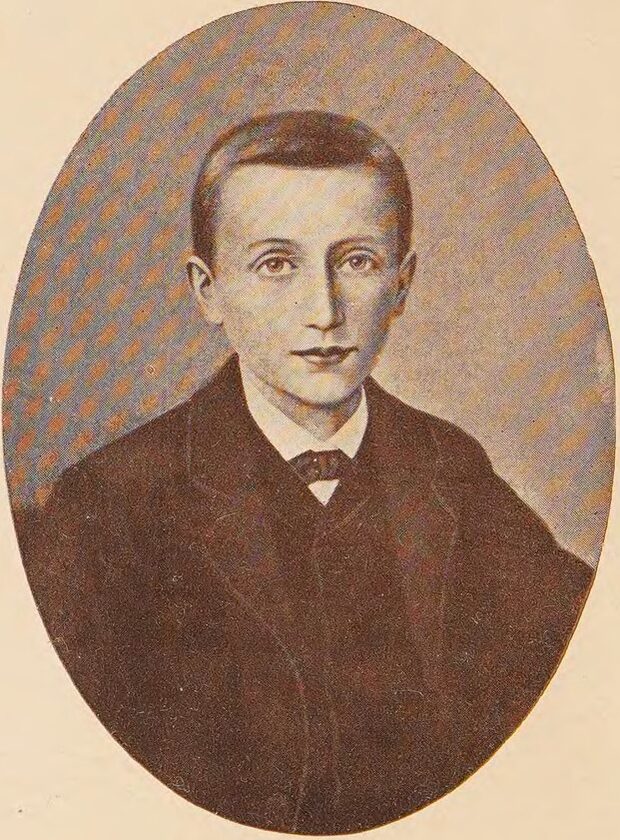 Historical devotional portrait of Dominic Savio. This is an illustration, not an authenticated lifetime photograph.
How faith in God shaped a teenager's courage, friendships, responsibilities and service to others.
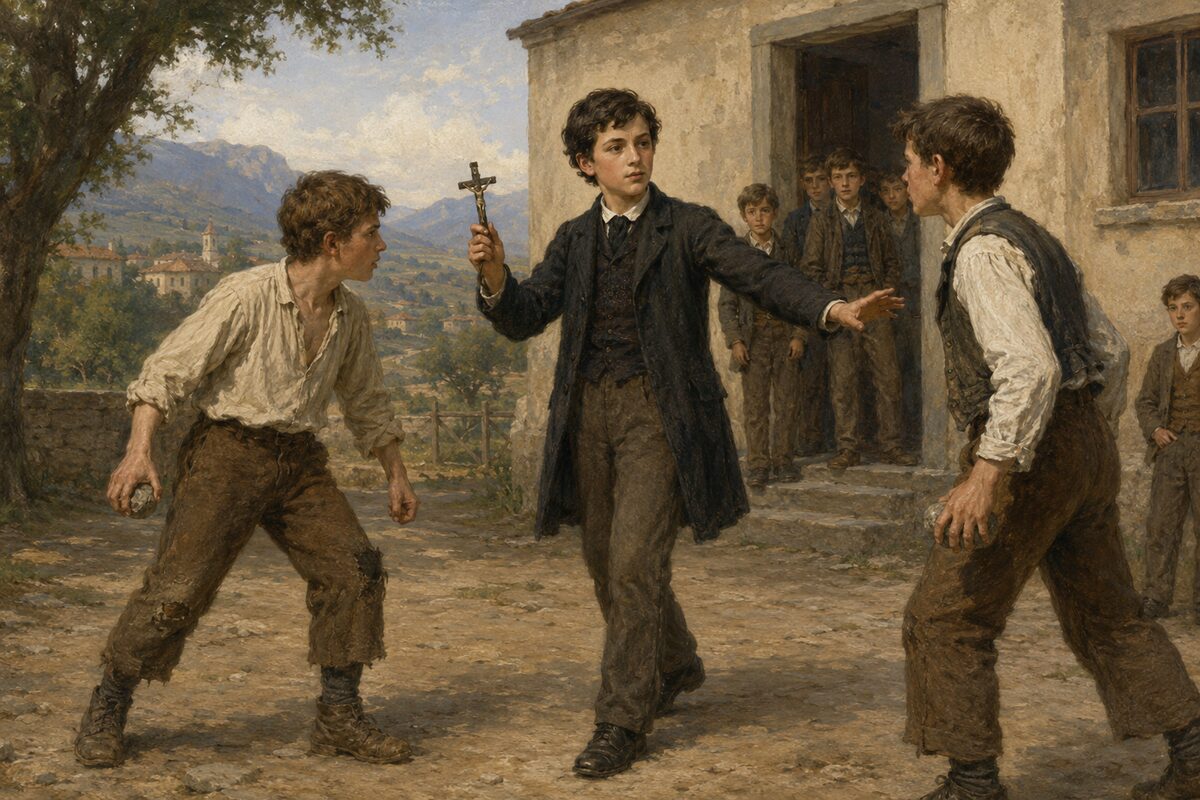 AI-generated illustration based on a peacemaking incident recounted by Don Bosco; not an authentic historical scene.
The Boy Who Stepped Between Two Angry Friends
Two older boys were preparing to settle an argument with stones. Reasoning had failed. Warnings had failed. Their anger had become stronger than their willingness to listen.
Dominic Savio was younger and physically weaker than both of them. He could have walked away. He could have called others and watched from a safe distance. Instead, according to the account written by his teacher Don Bosco, Dominic went with the boys to the place where they intended to fight. He stood between them, held up the small crucifix he wore and asked each boy to throw the first stone at him.
Neither could do it.
Dominic then asked them to look at Christ, who forgave his enemies, and to reconsider their planned revenge. Don Bosco recounts that the boys lowered their stones, abandoned the fight and later remembered Dominic's courage and kindness.1
The story is powerful because Dominic accepted a personal risk to prevent harm. He entered the conflict and placed friendship, conscience and faith between anger and injury.
That choice reveals the centre of his short life. For Dominic, belief in God was not only a private feeling. It shaped what he did in the classroom, in recreation, in friendship and when another person needed help.
“I Am the Cloth”: A Young Person Willing to Be Formed
On 2 October 1854, Dominic and his father met Don Bosco at the Becchi, near the place where Don Bosco had grown up. Dominic hoped to study in Turin and eventually become a priest. During their conversation, Don Bosco compared him to good material from which a garment might be made.
Don Bosco remembers Dominic accepting the comparison enthusiastically. He saw himself as cloth and Don Bosco as the tailor who could help form his life for Jesus.1
The image expresses teachability. Dominic had strong convictions, yet remained willing to learn, accept correction and be shaped.
He entered Don Bosco's Oratory of St Francis de Sales at Valdocco, Turin, on 29 October 1854.2 An oratory in Don Bosco's work was more than a place of prayer. It was a home, school, church and playground where boys could study, form friendships, receive guidance and grow in faith.
At Valdocco, Dominic studied seriously and joined community life. Accounts describe him as cheerful, dependable and attentive to struggling companions. Faith gave his ordinary duties a purpose.
When the Desire to Be Holy Needed Wise Direction
About six months after Dominic arrived at the Oratory, he heard a talk explaining that every person was called to holiness, that holiness was possible, and that God promised joy to those who sincerely sought it. Don Bosco writes that Dominic became unusually quiet and asked for help to become a saint.1
His first response was intense. He wanted long prayers and severe bodily penances. Don Bosco refused to permit such practices. Dominic's health was fragile, and spiritual enthusiasm without balance could have harmed him.
Instead, Don Bosco guided him towards a healthier path: remain cheerful, fulfil the duties of study and prayer, take part in recreation, obey wise guidance and help other people.
This correction matters. Dominic is sometimes presented only as a child who already knew the right thing in every situation. His story is more useful when we see that he was also a learner. Good intentions did not remove his need for guidance.
Christian holiness, as Dominic learned it, was not an escape from daily life. It was a way of living daily life with love. Study, rest, play, friendship, prayer, health and obedience all mattered.
Holiness That Noticed the Lonely Person
Don Bosco tells of a boy named Camillo Gavio who arrived at the Oratory after a serious illness. He was away from home, surrounded by strangers and stood sadly while the other boys played.
Dominic noticed him.
He approached Gavio, began a conversation and offered friendship. In Don Bosco's account, Dominic explained the spirit of the Oratory with a short phrase: “making holiness consist in being happy.”1 He connected that happiness with avoiding wrongdoing, faithfully doing one's duties and serving God with gladness.
This was not shallow cheerfulness. Dominic did not tell an unwell and lonely boy simply to smile. He first saw him, went to him and listened. Joy became credible because it arrived through companionship.
The incident offers a practical test of faith. It is easy to speak about kindness in general. It is harder to notice the person standing alone—the new student, homesick colleague or quiet neighbour.
Dominic's first gift to Gavio was not advice. It was attention.
Illness, Farewell and a Short Life with Lasting Meaning
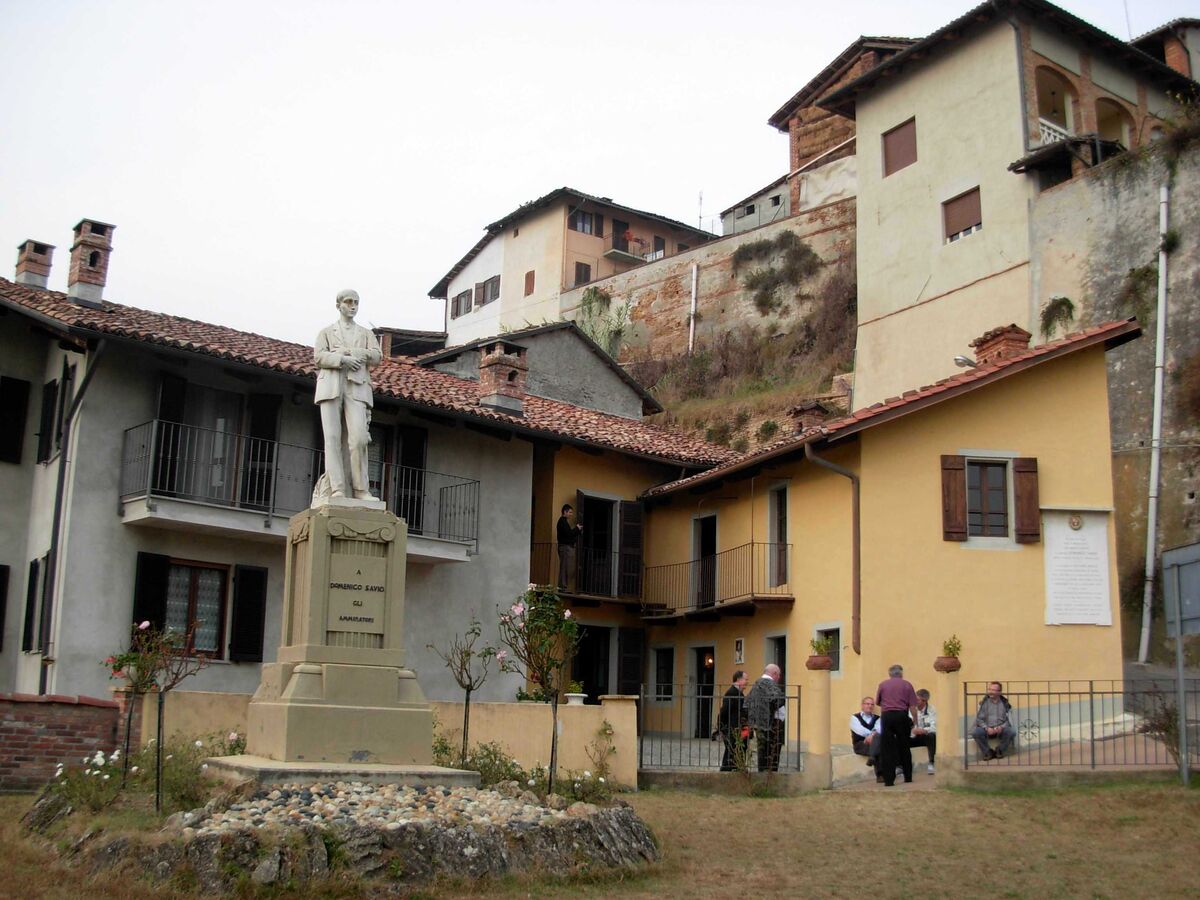 The historic house at Mondonio associated with Dominic Savio's final days. Photograph by Stebunik, cropped and resized, licensed under CC BY-SA 3.0.
Dominic's health weakened during his years at Valdocco. On 1 March 1857, he left Turin for his family home at Mondonio. Don Bosco's account describes coughing, inflammation and the medical practice of bloodletting. It is not responsible to assign a precise modern diagnosis or to claim with certainty that the treatment caused his death.
Dominic died at Mondonio on the evening of 9 March 1857. He was fourteen years old, only a few weeks short of his fifteenth birthday.23
Dominic was beatified by Pope Pius XII on 5 March 1950 and canonised on 12 June 1954.34 The Catholic Church's recognition did not rest on political power, wealth, scholarship or a long public career. It presented the life of a teenager as evidence that Christian maturity can be found in faithful choices made within ordinary days.
What Dominic Savio's Life Can Teach Us
Dominic lived in a particular Catholic culture in nineteenth-century Italy, but several lessons cross the boundaries of age, country and background.
Do not wait for a dramatic opportunity to live well
Most lives are shaped by small choices: completing work honestly, keeping a promise, controlling an angry response, making time for prayer or reflection, and helping without seeking attention.
Let courage protect, not dominate
In the stone-fight story, Dominic did not use courage to prove that he was stronger. He used it to prevent injury and restore peace. Real courage often places another person's good above our desire to win.
Welcome guidance
Dominic's willingness to be “cloth” in the hands of a wise teacher is a reminder that enthusiasm needs formation. A trusted parent, teacher, spiritual guide or experienced friend can help us distinguish devotion from excess and courage from recklessness.
Notice who is standing alone
The meeting with Gavio offers a simple action for any reader: look around. Who is new, lonely, unwell, discouraged or ignored? A sincere conversation may carry more hope than a grand speech.
Words to Remember
“… I am the material: you are the tailor; so take me with you and make a nice suit for the Lord.”
This is not a call to lose one's personality. It is an invitation to remain teachable and allow truth, grace and wise guidance to shape one's gifts.
A Meaningful Life Is Not Measured Only by Years
Dominic Savio did not have time to build a career, write a major book or lead a public movement. His influence grew from something quieter: a faith that entered his friendships, duties, decisions and concern for others.
His story does not ask every reader to imitate every devotional practice of a nineteenth-century Catholic boy. It asks a more direct question: What would change if we treated today's ordinary responsibilities as opportunities to love God and serve people?
Begin with one action. Complete one duty faithfully. Welcome one person who feels alone. Seek guidance in one area where enthusiasm has lost balance. Take one safe step towards peace.
A short life can leave a long light when ordinary days are filled with courage, friendship, faithfulness and hope.
DataTorch Closing Thought
Holiness does not always announce itself through extraordinary achievements. Sometimes it appears when a person does the next duty with love, welcomes the one who stands alone and chooses peace when anger would be easier.
Sources
- John Bosco, The Life of Young Dominic Savio, English Salesian edition. This near-contemporary work is also an educational and edifying biography; significant incidents and dialogue above are therefore attributed to Don Bosco.
- Salesians of Don Bosco, “Dominic Savio”.
- Dicastery for the Causes of Saints, “Domenico Savio”.
- Pope Pius XII, canonisation address, 12 June 1954.
Images: Public-domain historical devotional portrait from an old book scan, available through Wikimedia Commons; original DataTorch AI-generated peacemaking illustration, clearly labelled as an interpretive scene; and Mondonio house photograph by Stebunik, cropped and resized, licensed under CC BY-SA 3.0.
Last fact-checked: 29 July 2026.