Alfred Nobel -The merchant of death
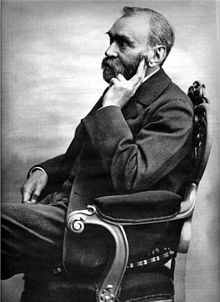 Alfred Bernhard Nobel
Imagine opening the morning newspaper, turning to the obituaries, and seeing your own name. Now imagine that the obituary doesn't celebrate your life, but instead condemns you as a monster.
For Alfred Nobel, a brilliant 19th-century Swedish chemist, engineer, and inventor, this wasn't a hypothetical scenario. It was a very real, terrifying wake-up call—one that profoundly altered the course of history and gave humanity its most prestigious award.
The Empire of Explosives
Born in 1833, Alfred Nobel was a man of intense intellect and curiosity. Throughout his life, he amassed 355 different patents, but he was most famous for one specific, world-altering invention: dynamite.
By discovering a way to safely package and detonate volatile nitroglycerin, Nobel revolutionized industries worldwide. His invention made mining safer, allowed railroads to blast through impenetrable mountains, and facilitated massive construction projects. However, dynamite was also rapidly adopted by the military. Nobel’s explosive innovations became weapons of war, capable of inflicting unprecedented destruction and loss of life.
Nobel amassed a staggering fortune from his massive network of explosive factories, but he viewed himself as a pacifist. He naively hoped that his weapons would be so terrible that they would deter nations from ever going to war again. The world, however, saw him differently.
"The Merchant of Death is Dead"
In 1888, Alfred’s brother, Ludvig Nobel, passed away in Cannes, France. Due to a monumental journalistic error, a major French newspaper confused Ludvig with Alfred. Believing the infamous inventor of dynamite had died, the publication printed a scathing, premature obituary.
The headline was brutal and uncompromising:
"Le marchand de la mort est mort." (The merchant of death is dead.)
The obituary went on to describe Alfred Nobel as a man who "became rich by finding ways to kill more people faster than ever before."
Nobel read the article in absolute horror. He was faced with a chilling reality: this was exactly how the world was going to remember him. His life’s work, his passion for science, and his personal pacifist ideals were entirely eclipsed by the destructive power of his creations. He was destined to be immortalized as a purveyor of death.
The Ultimate Rewrite
Nobel could not un-invent dynamite, but the premature obituary sparked a profound realization: he still had time to change the ending of his story.
Over the next several years, Nobel quietly went to work on restructuring his vast estate. When he actually passed away in 1896, his family and the world were stunned by the contents of his last will and testament.
Nobel directed that 94% of his enormous fortune—amounting to roughly 31 million Swedish kronor (hundreds of millions of dollars today)—be placed into a fund. The interest generated by this immense wealth was to be distributed annually as prizes to those who, during the preceding year, "shall have conferred the greatest benefit to humankind."
With a single stroke of his pen, the "Merchant of Death" created the Nobel Prize.
The Power of the Pen is Yours
Alfred Nobel’s story is one of the most dramatic historical examples of redemption. It serves as a striking reminder that our legacy is not fixed until our final day.
Very few of us will ever have the opportunity to read our own obituaries while we are still alive. But Nobel’s terrifying morning in 1888 offers us a beautiful, inspiring question to ask ourselves today: If your story ended right now, how would you be remembered?
More importantly, it teaches us that if we don't like the answer to that question, we have the power to change it. We are not bound by our past mistakes, the labels others have placed on us, or the unintended consequences of our past actions. Like Nobel, we hold the pen. Every single day is an opportunity to redirect our energy, to build instead of destroy, to help instead of harm, and to leave the world a little brighter than we found it.